
• Tech
    • Tech Category
      • Engine
      • Bottom End
      • Rods and Pistons
      • Head and Headwork
      • Cams and Valvetrain
      • Cooling and Heat Management
      • Intake
      • Headers and Exhaust
      • Rotary
      • Engine Management and Tuning
      • Drivetrain
      • Transmission
      • Clutch and Flywheel
      • Differential and Final Drive
      • Driveshaft and Axle
      • Axles
    • Tech Category
      • Suspension
      • Shocks and Coilovers
      • Springs
      • Swaybars
      • Arms and Links
      • Bushings
      • Steering
      • Geometry Correction
      • Suspension Setup and Tuning
      • Brakes
      • Wheels and Tires
      • Fueling
      • Forced Induction and NOS
      • Aerodynamics
    • Tech Cat
      • Electrical
      • Battery and Power Distribution
      • Electronics
      • Wiring
      • Electrical System Education and Troubleshooting
      • Lubrication
      • Interior and Controls
      • Exterior
      • Paint and Bodywork
      • Wraps and Film Protection
      • Exterior Care and Maintenance
      • Data Acquisition and Tuning
      • Fabrication and Safety
      • Tips and How-To
  • Projects
    • Make A-D
      • Acura
      • Integra (DC2)
      • NSX
      • CSF RSX (DC5)
      • BMW
      • E30 (SR20 Powered)
      • E36 323is
      • E36 M3 (Black)
      • E36 M3 (Silver)
      • E39 M5
      • E46 M3
      • E90 M3
      • E46 Racecar
      • Yost Auto E92 M3
      • Yost Auto F82 M4
      • Chevrolet
      • Camaro Gen5
      • Corvette Stingray (C7 Z51)
      • Corvette Stingray (C8 Z51)
      • GMC Canyon
      • Dodge
      • Viper GTS
    • Make E-I
      • Ford
      • E350 Tow Rig
      • F150 EcoBoost
      • Fiesta ST
      • Focus ST
      • Mustang 5.0 (Grey)
      • Mustang 5.0 (White)
      • Mustang S197 (Budget Track Car)
      • Mustang S550 GT
      • Honda
      • Civic EF Racecar
      • Civic Si (Coupe)
      • Civic Si (EP3)
      • Civic Si (Saloon)
      • EJ Civic
      • Polystrand CRX
      • S2000 (AP1)
      • S2000 (AP2)
      • Infiniti
      • G20 Racecar
      • G20 (P10 AWD Turbo)
      • G35
      • G37S
    • Make J-M
      • Isuzu
      • Vehicross
      • Lexus
      • ISF
      • SC300
      • Mazda
      • V8 RX7 (3rd Gen)
      • RX-7 (3rd Gen)
      • RX-7 Restomod (3rd Gen)
      • Skyactiv 3
      • Frankenmiata
      • Miatabusa
      • My Girlfriend’s Miata
      • Mitsubishi
      • EVO VIII
      • EVO IX
      • EVO X
      • CSF EVO X Racecar
      • Professional Awesome EVO VIII
    • Make N-P
      • Nissan
      • 200SX
      • 200SX SE-R
      • 240SX Land Speed Racer
      • 300ZXTT
      • 350Z
      • 350Z Drift Car
      • 370Z
      • GT-R (R33)
      • GT-R (R35)
      • GT-R (Team America BNR32)
      • LS S13
      • NX GTi-R
      • Pathfinder
      • S13 Drift/Grip Do-it-All Mega 240
      • Sentra SE-R
      • Sentra Spec V
      • Silvia
      • STurdteen Drift Car
      • Porsche
      • 991 GT3RS
      • Cayman (987)
      • Cayman T
      • Cayman GTS 4.0
    • Make S-Z
      • Scion
      • FR-S
      • Scion Tuner Challenge FR-S
      • TC
      • Subaru
      • Autocross BRZ
      • Legacy GT
      • STI (gen 2)
      • STI (gen 3)
      • WRX (GD)
      • WRX (VA)
      • Toyota
      • 4Runner
      • AE86 Corolla
      • GR Corolla
      • Starletabusa
      • Supra Mark IV
      • Tacoma
      • Tundra
      • Volkswagen
      • MKIV Jetta TDI
      • MKVI Golf TDI
      • MKVII Golf R
      • Sipster (Rabbit)
    • Other Projects
      • Powersports
      • Aprilia RS50
      • Aprilia SR50
      • Doodlebug
      • Ducati 998
      • Ducati Hypermotard
      • Honda Ruckus
      • Husqvarna TE610
      • Go Karts
      • Other
      • Sim Racer
      • Aurora Cobra
      • Garage
      • NP01 Prototype
  • Features
    • Features
      • Feature Cars
      • Drag Race Cars
      • Drift Cars
      • Land Speed Cars
      • Open-Wheel Cars
      • Rally Cars
      • Road Race Cars
      • Street Cars
      • Time Attack Cars
      • Drag Racing
    • Features
      • Events
      • Drifting
      • Land Speed Racing
      • Open-Wheel Racing
      • Time Attack Racing
      • Rally Racing
      • Road Racing
      • Car Shows
      • Columns
      • SlipAngle Podcast
  • Video
  • Shop *NEW*
  • MotoIQ Garage Services
  • About
  • Shop *NEW*
  • MotoIQ Garage Services
  • About
MotoIQ
MotoIQ
  • Tech
    • Tech Category
      • Engine
      • Bottom End
      • Rods and Pistons
      • Head and Headwork
      • Cams and Valvetrain
      • Cooling and Heat Management
      • Intake
      • Headers and Exhaust
      • Rotary
      • Engine Management and Tuning
      • Drivetrain
      • Transmission
      • Clutch and Flywheel
      • Differential and Final Drive
      • Driveshaft and Axle
      • Axles
    • Tech Category
      • Suspension
      • Shocks and Coilovers
      • Springs
      • Swaybars
      • Arms and Links
      • Bushings
      • Steering
      • Geometry Correction
      • Suspension Setup and Tuning
      • Brakes
      • Wheels and Tires
      • Fueling
      • Forced Induction and NOS
      • Aerodynamics
    • Tech Cat
      • Electrical
      • Battery and Power Distribution
      • Electronics
      • Wiring
      • Electrical System Education and Troubleshooting
      • Lubrication
      • Interior and Controls
      • Exterior
      • Paint and Bodywork
      • Wraps and Film Protection
      • Exterior Care and Maintenance
      • Data Acquisition and Tuning
      • Fabrication and Safety
      • Tips and How-To
  • Projects
    • Make A-D
      • Acura
      • Integra (DC2)
      • NSX
      • CSF RSX (DC5)
      • BMW
      • E30 (SR20 Powered)
      • E36 323is
      • E36 M3 (Black)
      • E36 M3 (Silver)
      • E39 M5
      • E46 M3
      • E90 M3
      • E46 Racecar
      • Yost Auto E92 M3
      • Yost Auto F82 M4
      • Chevrolet
      • Camaro Gen5
      • Corvette Stingray (C7 Z51)
      • Corvette Stingray (C8 Z51)
      • GMC Canyon
      • Dodge
      • Viper GTS
    • Make E-I
      • Ford
      • E350 Tow Rig
      • F150 EcoBoost
      • Fiesta ST
      • Focus ST
      • Mustang 5.0 (Grey)
      • Mustang 5.0 (White)
      • Mustang S197 (Budget Track Car)
      • Mustang S550 GT
      • Honda
      • Civic EF Racecar
      • Civic Si (Coupe)
      • Civic Si (EP3)
      • Civic Si (Saloon)
      • EJ Civic
      • Polystrand CRX
      • S2000 (AP1)
      • S2000 (AP2)
      • Infiniti
      • G20 Racecar
      • G20 (P10 AWD Turbo)
      • G35
      • G37S
    • Make J-M
      • Isuzu
      • Vehicross
      • Lexus
      • ISF
      • SC300
      • Mazda
      • V8 RX7 (3rd Gen)
      • RX-7 (3rd Gen)
      • RX-7 Restomod (3rd Gen)
      • Skyactiv 3
      • Frankenmiata
      • Miatabusa
      • My Girlfriend’s Miata
      • Mitsubishi
      • EVO VIII
      • EVO IX
      • EVO X
      • CSF EVO X Racecar
      • Professional Awesome EVO VIII
    • Make N-P
      • Nissan
      • 200SX
      • 200SX SE-R
      • 240SX Land Speed Racer
      • 300ZXTT
      • 350Z
      • 350Z Drift Car
      • 370Z
      • GT-R (R33)
      • GT-R (R35)
      • GT-R (Team America BNR32)
      • LS S13
      • NX GTi-R
      • Pathfinder
      • S13 Drift/Grip Do-it-All Mega 240
      • Sentra SE-R
      • Sentra Spec V
      • Silvia
      • STurdteen Drift Car
      • Porsche
      • 991 GT3RS
      • Cayman (987)
      • Cayman T
      • Cayman GTS 4.0
    • Make S-Z
      • Scion
      • FR-S
      • Scion Tuner Challenge FR-S
      • TC
      • Subaru
      • Autocross BRZ
      • Legacy GT
      • STI (gen 2)
      • STI (gen 3)
      • WRX (GD)
      • WRX (VA)
      • Toyota
      • 4Runner
      • AE86 Corolla
      • GR Corolla
      • Starletabusa
      • Supra Mark IV
      • Tacoma
      • Tundra
      • Volkswagen
      • MKIV Jetta TDI
      • MKVI Golf TDI
      • MKVII Golf R
      • Sipster (Rabbit)
    • Other Projects
      • Powersports
      • Aprilia RS50
      • Aprilia SR50
      • Doodlebug
      • Ducati 998
      • Ducati Hypermotard
      • Honda Ruckus
      • Husqvarna TE610
      • Go Karts
      • Other
      • Sim Racer
      • Aurora Cobra
      • Garage
      • NP01 Prototype
  • Features
    • Features
      • Feature Cars
      • Drag Race Cars
      • Drift Cars
      • Land Speed Cars
      • Open-Wheel Cars
      • Rally Cars
      • Road Race Cars
      • Street Cars
      • Time Attack Cars
      • Drag Racing
    • Features
      • Events
      • Drifting
      • Land Speed Racing
      • Open-Wheel Racing
      • Time Attack Racing
      • Rally Racing
      • Road Racing
      • Car Shows
      • Columns
      • SlipAngle Podcast
  • Video
  • Tech

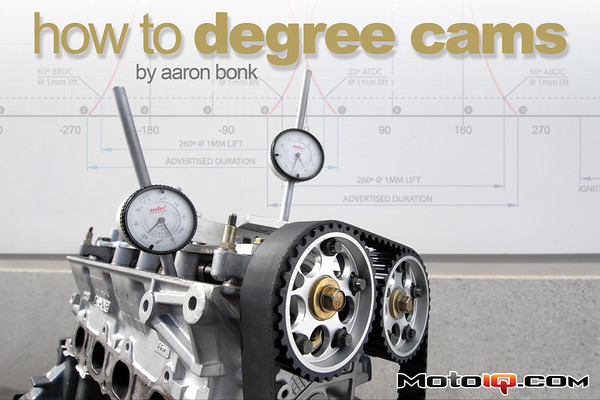
How To Degree Cams

  • Aaron LaBeau

,

DOING IT

There’s more than one way to degree cams but the centerline method is the most common. There are even multiple ways to perform the centerline method. However, the following procedure is arguably the most common. 

As explained, a cam may reach peak lift for several degrees of crankshaft rotation. Therefore, finding a cam’s peak lift won’t necessarily reveal its centerline. In order to find its centerline, you’ll need to locate the exact midpoint between when a particular valve opens and when it closes. For dual-overhead cam engines, the procedure must be followed twice — once for the intake and once for the exhaust. Typically, measurements are taken on the number one cylinder’s valves.


Step 1: Begin by positioning the number one piston at TDC using the engine’s and crank pulley’s marks and fasten the degree wheel in front of the crank pulley with its TDC mark pointing up. Remove any covers or other accessories to allow the wheel to sit flat. All of this is easiest with the engine on a stand but can also be done anywhere so long as you can fit the degree wheel into place and still read it.


Degree wheel
Most degree wheels are designed for clockwise-spinning engines. This degree wheel was relabeled to make cam degreeing counter-clockwise-spinning Honda engines a bit less painful.


Step 2: Find a short piece of welding rod or a metal coat hanger, bend it into a “J” shape, and sharpen its long end to a point. Slide a bolt through its bent end and fasten it to the engine near the degree wheel. Bend the rod so that its sharpened end points toward the degree wheel’s TDC mark.


TDC reference pointer
A piece of aluminum welding rod bent and fastened to the block makes for a good reference pointer.


Step 3: When degreeing cams, never rely on the engine’s pulley, block, or timing belt/chain cover marks to pinpoint TDC. Variables like block height, inconsistent keyways, and piston dwell often make such methods inaccurate by as much as five degrees. Instead, use the piston-stop method to determine precisely when the piston’s reached its absolute highest point as well as the middle of its dwell. Begin by rotating the crank approximately 15 degrees in its normal operating direction so that its number one piston is just past the approximate TDC location you found earlier. Thread a piston-stop into its spark plug hole until it touches the number one piston. If you don’t have a piston stop, you can use a customized spark plug or fabricate your own piston stop out of anything rigid that threads into the spark plug hole and touches the piston just past TDC. 


Piston stop
You can buy a fancy piston stop or make one out of an old spark plug and some spare hardware. Just about anything that’ll thread into the spark plug hole and prevent the piston from reaching TDC will work.


Step 4: Continue to rotate the crank in its normal direction of rotation until the piston contacts the piston stop and record the degree wheel value corresponding with the pointer. Rotate the engine in the opposite direction until the piston contacts the piston-stop again and record that value. If both figures are the same, you’ve lucked out and have already located TDC. Usually, though, those two numbers will be different. True TDC lies halfway between them. For example, say that you’ve first recorded 26 degrees BTDC and then 22 degrees ATDC. Add the two numbers together, divide the result by two, and you get 24. Next, reposition the pointer halfway between the two, which in this case is exactly 24 degrees apart from each previously recorded value. Be sure that the pointer is dead-on and don’t disturb it. The math should appear as follows:

First Reading (26° BTDC) + Second Reading (22° ATDC) = 48° 

48° / 2 = 24°


Step 5: Remove the piston stop and rotate the crank so that the pointer lines up with the degree wheel’s TDC mark. You’ve now accurately located TDC and, chances are, it’s not where your timing cover and crank pulley say it should be. If you’re not sure that you did this step correctly or your wire or crank get bumped out of position, start over. The cam degreeing process is only as accurate as its initial TDC location.

 

Related

Previous page 1 2 3 4 5Next page
Previous Article
  • Projects
  • Husqvarna TE610
  • Powersports

Project Husqvarna TE610 Part 1: Dual Sport Adventure Bike Options

  • DanBarnes
View Post
Next Article
  • Features

Performance Friction Wins 47 Motorsports Championships

  • Jeff Naeyaert
View Post
6 comments
  1. liam says:
    October 2, 2023 at 2:25 pm

    Hi there, got a couple of kelford 166852 sr20ve cams, just wondering when you degree sr20ve cams is the spec sheet go off the smaller outer lobes or the larger centre lobes. If its the larger lobe (which i believe so) how do you degree them on the bench with that centre part of the rocker spungy(no oil pressure to firm it).

    Reply
    1. Avatar photo Mike Kojima says:
      October 2, 2023 at 3:39 pm

      I would contact Kelford and ask which lobe they degree off of. Personally I would do the low rpm lobe off of the sheet.

      Reply
  2. Greg says:
    January 9, 2024 at 4:44 pm

    Great explanation.
    I degreed my cams according to this procedure in my B18CR. Cams are Skunk Tuner Two’s.
    My question is, if the cams are removed and reinstalled without disturbing the sprockets, is it necessary to redegree?

    Reply
    1. Avatar photo Mike Kojima says:
      January 9, 2024 at 10:35 pm

      No

      Reply
  3. SALtech says:
    February 18, 2024 at 9:28 am

    Hi. If a Head/cam has been degreed on one particular engine, and you put that same head on another engine with different headgasket etc, is it then nessecary to degree the cams again ?

    Reply
    1. Avatar photo Mike Kojima says:
      February 18, 2024 at 9:39 pm

      Yes

      Reply

Leave a Reply Cancel reply

Your email address will not be published. Required fields are marked *

Input your search keywords and press Enter.