• Tech
    • Tech Category
      • Engine
      • Bottom End
      • Rods and Pistons
      • Head and Headwork
      • Cams and Valvetrain
      • Cooling and Heat Management
      • Intake
      • Headers and Exhaust
      • Rotary
      • Engine Management and Tuning
      • Drivetrain
      • Transmission
      • Clutch and Flywheel
      • Differential and Final Drive
      • Driveshaft and Axle
      • Axles
    • Tech Category
      • Suspension
      • Shocks and Coilovers
      • Springs
      • Swaybars
      • Arms and Links
      • Bushings
      • Steering
      • Geometry Correction
      • Suspension Setup and Tuning
      • Brakes
      • Wheels and Tires
      • Fueling
      • Forced Induction and NOS
      • Aerodynamics
    • Tech Cat
      • Electrical
      • Battery and Power Distribution
      • Electronics
      • Wiring
      • Electrical System Education and Troubleshooting
      • Lubrication
      • Interior and Controls
      • Exterior
      • Paint and Bodywork
      • Wraps and Film Protection
      • Exterior Care and Maintenance
      • Data Acquisition and Tuning
      • Fabrication and Safety
      • Tips and How-To
  • Projects
    • Make A-D
      • Acura
      • Integra (DC2)
      • NSX
      • CSF RSX (DC5)
      • BMW
      • E30 (SR20 Powered)
      • E36 323is
      • E36 M3 (Black)
      • E36 M3 (Silver)
      • E39 M5
      • E46 M3
      • E90 M3
      • E46 Racecar
      • Yost Auto E92 M3
      • Yost Auto F82 M4
      • Chevrolet
      • Camaro Gen5
      • Corvette Stingray (C7 Z51)
      • Corvette Stingray (C8 Z51)
      • GMC Canyon
      • Dodge
      • Viper GTS
    • Make E-I
      • Ford
      • E350 Tow Rig
      • F150 EcoBoost
      • Fiesta ST
      • Focus ST
      • Mustang 5.0 (Grey)
      • Mustang 5.0 (White)
      • Mustang S197 (Budget Track Car)
      • Mustang S550 GT
      • Honda
      • Civic EF Racecar
      • Civic Si (Coupe)
      • Civic Si (EP3)
      • Civic Si (Saloon)
      • EJ Civic
      • Polystrand CRX
      • S2000 (AP1)
      • S2000 (AP2)
      • Infiniti
      • G20 Racecar
      • G20 (P10 AWD Turbo)
      • G35
      • G37S
    • Make J-M
      • Isuzu
      • Vehicross
      • Lexus
      • ISF
      • SC300
      • Mazda
      • V8 RX7 (3rd Gen)
      • RX-7 (3rd Gen)
      • RX-7 Restomod (3rd Gen)
      • Skyactiv 3
      • Frankenmiata
      • Miatabusa
      • My Girlfriend’s Miata
      • Mitsubishi
      • EVO VIII
      • EVO IX
      • EVO X
      • CSF EVO X Racecar
      • Professional Awesome EVO VIII
    • Make N-P
      • Nissan
      • 200SX
      • 200SX SE-R
      • 240SX Land Speed Racer
      • 300ZXTT
      • 350Z
      • 350Z Drift Car
      • 370Z
      • GT-R (R33)
      • GT-R (R35)
      • GT-R (Team America BNR32)
      • LS S13
      • NX GTi-R
      • Pathfinder
      • S13 Drift/Grip Do-it-All Mega 240
      • Sentra SE-R
      • Sentra Spec V
      • Silvia
      • STurdteen Drift Car
      • Porsche
      • 991 GT3RS
      • Cayman (987)
      • Cayman T
      • Cayman GTS 4.0
    • Make S-Z
      • Scion
      • FR-S
      • Scion Tuner Challenge FR-S
      • TC
      • Subaru
      • Autocross BRZ
      • Legacy GT
      • STI (gen 2)
      • STI (gen 3)
      • WRX (GD)
      • WRX (VA)
      • Toyota
      • 4Runner
      • AE86 Corolla
      • GR Corolla
      • Starletabusa
      • Supra Mark IV
      • Tacoma
      • Tundra
      • Volkswagen
      • MKIV Jetta TDI
      • MKVI Golf TDI
      • MKVII Golf R
      • Sipster (Rabbit)
    • Other Projects
      • Powersports
      • Aprilia RS50
      • Aprilia SR50
      • Doodlebug
      • Ducati 998
      • Ducati Hypermotard
      • Honda Ruckus
      • Husqvarna TE610
      • Go Karts
      • Other
      • Sim Racer
      • Aurora Cobra
      • Garage
      • NP01 Prototype
  • Features
    • Features
      • Feature Cars
      • Drag Race Cars
      • Drift Cars
      • Land Speed Cars
      • Open-Wheel Cars
      • Rally Cars
      • Road Race Cars
      • Street Cars
      • Time Attack Cars
      • Drag Racing
    • Features
      • Events
      • Drifting
      • Land Speed Racing
      • Open-Wheel Racing
      • Time Attack Racing
      • Rally Racing
      • Road Racing
      • Car Shows
      • Columns
      • SlipAngle Podcast
  • Video
  • Shop *NEW*
  • MotoIQ Garage Services
  • About
  • Shop *NEW*
  • MotoIQ Garage Services
  • About
MotoIQ
MotoIQ
  • Tech
    • Tech Category
      • Engine
      • Bottom End
      • Rods and Pistons
      • Head and Headwork
      • Cams and Valvetrain
      • Cooling and Heat Management
      • Intake
      • Headers and Exhaust
      • Rotary
      • Engine Management and Tuning
      • Drivetrain
      • Transmission
      • Clutch and Flywheel
      • Differential and Final Drive
      • Driveshaft and Axle
      • Axles
    • Tech Category
      • Suspension
      • Shocks and Coilovers
      • Springs
      • Swaybars
      • Arms and Links
      • Bushings
      • Steering
      • Geometry Correction
      • Suspension Setup and Tuning
      • Brakes
      • Wheels and Tires
      • Fueling
      • Forced Induction and NOS
      • Aerodynamics
    • Tech Cat
      • Electrical
      • Battery and Power Distribution
      • Electronics
      • Wiring
      • Electrical System Education and Troubleshooting
      • Lubrication
      • Interior and Controls
      • Exterior
      • Paint and Bodywork
      • Wraps and Film Protection
      • Exterior Care and Maintenance
      • Data Acquisition and Tuning
      • Fabrication and Safety
      • Tips and How-To
  • Projects
    • Make A-D
      • Acura
      • Integra (DC2)
      • NSX
      • CSF RSX (DC5)
      • BMW
      • E30 (SR20 Powered)
      • E36 323is
      • E36 M3 (Black)
      • E36 M3 (Silver)
      • E39 M5
      • E46 M3
      • E90 M3
      • E46 Racecar
      • Yost Auto E92 M3
      • Yost Auto F82 M4
      • Chevrolet
      • Camaro Gen5
      • Corvette Stingray (C7 Z51)
      • Corvette Stingray (C8 Z51)
      • GMC Canyon
      • Dodge
      • Viper GTS
    • Make E-I
      • Ford
      • E350 Tow Rig
      • F150 EcoBoost
      • Fiesta ST
      • Focus ST
      • Mustang 5.0 (Grey)
      • Mustang 5.0 (White)
      • Mustang S197 (Budget Track Car)
      • Mustang S550 GT
      • Honda
      • Civic EF Racecar
      • Civic Si (Coupe)
      • Civic Si (EP3)
      • Civic Si (Saloon)
      • EJ Civic
      • Polystrand CRX
      • S2000 (AP1)
      • S2000 (AP2)
      • Infiniti
      • G20 Racecar
      • G20 (P10 AWD Turbo)
      • G35
      • G37S
    • Make J-M
      • Isuzu
      • Vehicross
      • Lexus
      • ISF
      • SC300
      • Mazda
      • V8 RX7 (3rd Gen)
      • RX-7 (3rd Gen)
      • RX-7 Restomod (3rd Gen)
      • Skyactiv 3
      • Frankenmiata
      • Miatabusa
      • My Girlfriend’s Miata
      • Mitsubishi
      • EVO VIII
      • EVO IX
      • EVO X
      • CSF EVO X Racecar
      • Professional Awesome EVO VIII
    • Make N-P
      • Nissan
      • 200SX
      • 200SX SE-R
      • 240SX Land Speed Racer
      • 300ZXTT
      • 350Z
      • 350Z Drift Car
      • 370Z
      • GT-R (R33)
      • GT-R (R35)
      • GT-R (Team America BNR32)
      • LS S13
      • NX GTi-R
      • Pathfinder
      • S13 Drift/Grip Do-it-All Mega 240
      • Sentra SE-R
      • Sentra Spec V
      • Silvia
      • STurdteen Drift Car
      • Porsche
      • 991 GT3RS
      • Cayman (987)
      • Cayman T
      • Cayman GTS 4.0
    • Make S-Z
      • Scion
      • FR-S
      • Scion Tuner Challenge FR-S
      • TC
      • Subaru
      • Autocross BRZ
      • Legacy GT
      • STI (gen 2)
      • STI (gen 3)
      • WRX (GD)
      • WRX (VA)
      • Toyota
      • 4Runner
      • AE86 Corolla
      • GR Corolla
      • Starletabusa
      • Supra Mark IV
      • Tacoma
      • Tundra
      • Volkswagen
      • MKIV Jetta TDI
      • MKVI Golf TDI
      • MKVII Golf R
      • Sipster (Rabbit)
    • Other Projects
      • Powersports
      • Aprilia RS50
      • Aprilia SR50
      • Doodlebug
      • Ducati 998
      • Ducati Hypermotard
      • Honda Ruckus
      • Husqvarna TE610
      • Go Karts
      • Other
      • Sim Racer
      • Aurora Cobra
      • Garage
      • NP01 Prototype
  • Features
    • Features
      • Feature Cars
      • Drag Race Cars
      • Drift Cars
      • Land Speed Cars
      • Open-Wheel Cars
      • Rally Cars
      • Road Race Cars
      • Street Cars
      • Time Attack Cars
      • Drag Racing
    • Features
      • Events
      • Drifting
      • Land Speed Racing
      • Open-Wheel Racing
      • Time Attack Racing
      • Rally Racing
      • Road Racing
      • Car Shows
      • Columns
      • SlipAngle Podcast
  • Video
  • WRX (GD)
  • Tech
  • STI (gen 2)
  • Projects
  • Subaru

Project GD STI, IAG’s new high capacity EJ Oil Pump!

  • Mike Kojima

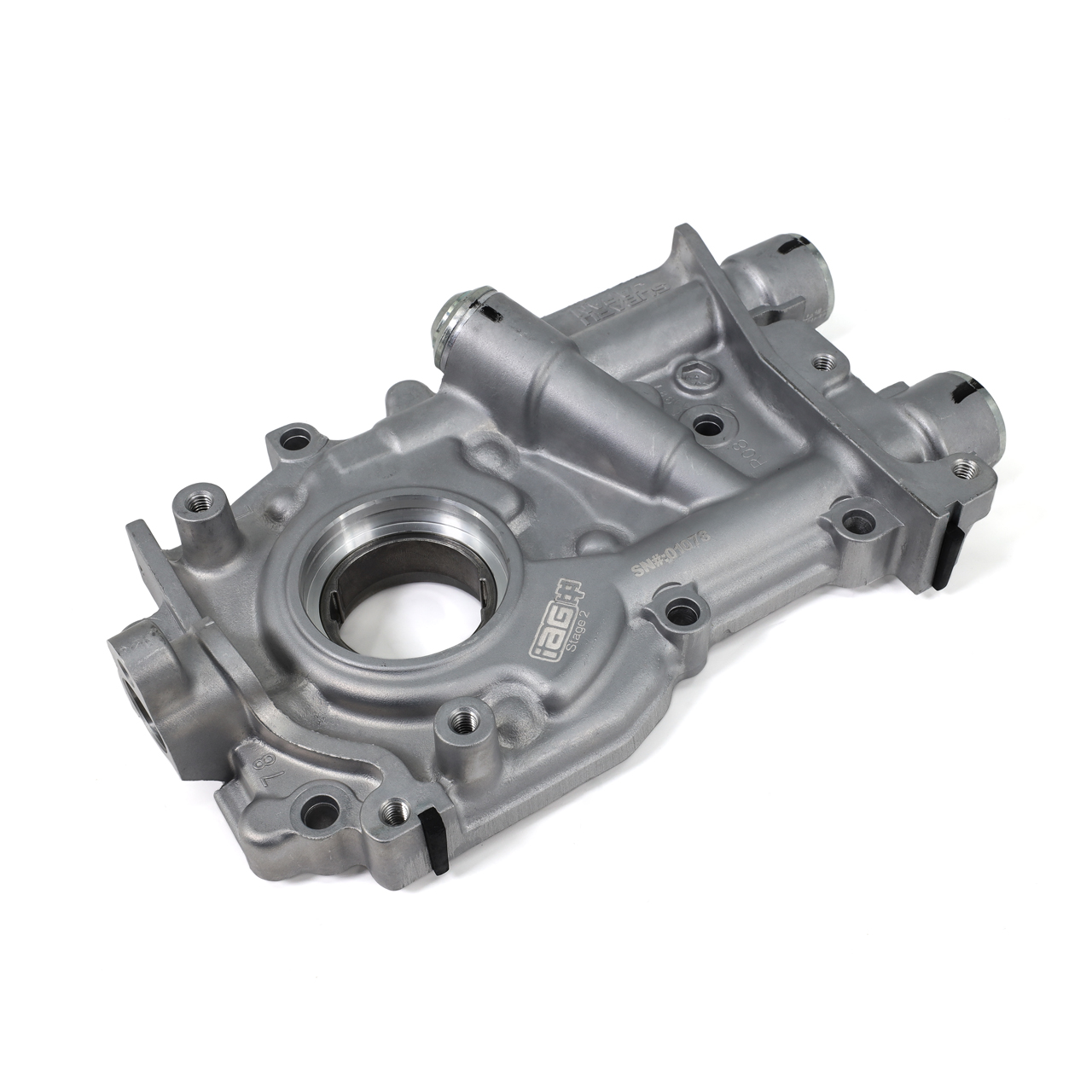
IAG has just dropped their Stage 1 and Stage 2 oil pumps for all EJ engines.  We will be using their Stage 2 pump on our own Project GD STI. The IAG Stage 2 pump has been blueprinted and modified to improve both pressure and flow volume over even the JDM 12mm pump that a lot of people install on their modded engines.

IAG starts with a brand new OEM Subaru 11mm pump.  IAG uses an 11mm pump as the basis of their pump because in their testing their Stage 2 pump outflows a similarly modded 12mm pump! The other reason is that the 12mm pump is not readily available in the USA and must be imported from Japan at a substantially higher price. IAG is currently working on developing mods for the 12mm pump and if they can get it to give a significant advantage over the 11mm, it will be available for sale as well.

You can see all of the torque verification marks all over every fastener of the IAG pump.  This is part of their extensive quality control process.  You can read about IAG’s advanced manufacturing technology and quality here.

Here you can see the CNC porting of the pump’s outlet port.  The porting is done to reduce pressure drop, increase flow, and reduce the risk of cavitation.

Here is the CNC porting of the pump’s inlet port.  CNC porting reduces any variables associated with hand porting the passages.
Related

1 2Next page
Related Topics
  • Engine
  • Bottom End
  • EJ257
  • Oil Pump
  • EJ20
  • EJ205
  • IAG Performance
  • EJ25
  • IAG
Previous Article
  • Tech

Project Fried Turkey

  • Jeff Naeyaert
View Post
Next Article
  • Tech

TESTED: Antigravity Batteries XP-10 MICRO-START Jump Starter

  • Erik Jacobs
View Post
7 comments
  1. Bob says:
    November 30, 2021 at 4:53 pm

    for the uninformed, whats the problem with the OEM pump? I mean I can see this provides more pressure, but what benefit does that higher pressure provide? asking for a friend

    Reply
    1. Avatar photo Mike Kojima says:
      November 30, 2021 at 7:35 pm

      Having enough pressure and volume is always an issue on late model engines, especially with aluminum blocks.

      Reply
  2. RedX says:
    December 1, 2021 at 2:10 am

    This is good stuff, I guess pretty equivalent to what RCM does over in the UK, but at least part of this work anyone can do to their OEM pump.
    I myself did. I dismantled the pump completely and checked the components with a micrometer, gap gauges and a straight steel ruler according to the factory manual. Then I torqued the lid bolts to spec. I did not shim the pressure relief valve though, as I am not convinced about the benefit. I have never really seen an unmodified sportscar or a factory race car with higher oil pressure than circa 6.5 bar or so. I believe those engineers know their reasons. I also believe that trying to squeeze a needlessly big volume of fluid through an orifice needs a lot of mechanical power and strains the fluid more, resulting in added heat.
    But maybe the benefits outweigh the cons.
    (I faintly remember I once read that Porsche 917 or some other old porsche racecar needed 8.4 bar of pressure to keep the conrod bearings properly lubricated)

    What I think many people fail to grasp is why subaru opted for the ever bigger oil pumps. People just assume bigger pump provides better lubrication. And higher power motors need more oil, right?
    That I believe is not true, or it least it is a gross oversimplification. I am strongly convinced this has to do with the ever higher oil demand for the devices peripheral to the rotating assembly itself.

    On smaller, naturally aspirated EJ engines (ej16, 18, 20), subaru used to use the 8 or 9 mm thick oil pump rotor. Once they added a turbocharger, they needed more oil (larger quantity), so the 10 mm rotor was used. Then the valve timing on intake cam was added, so the 11 mm rotor was used. Finally, exhaust cam timing was introduced and that’s where the 12 mm rotor came in.

    When I was working on a friend’s EJ20 out of his JDM GC8 STI with no variable timing and 10 mm stock oil pump, everyone was like, dude, just use the 12 mm pump, everybody does that! And I said nope and ordered a Roger Clark Motorsport blueprinted 10 mm pump.
    Ever since, this car displays an excellent oil pressure readings. Even when hot, the pressure gauge is pegged at maximum 6 bar from circa 3500 RPM upwards. This tells me that the journals are not worn and that there is ample supply of oil for the engine’s demands.
    How would a 12 mm pump with more flow help, when most of the flow would end up recirculated through the relief valve?

    Many people think the bigger pump will solve their oiling issues, but most of the time, the real cause lies elsewhere.

    Well yea, this my two cents. Partly researched, partly my own experience and of course it might differ from yours, but for what it’s wirth I think it holds water.

    Reply
    1. Avatar photo Mike Kojima says:
      December 1, 2021 at 8:51 am

      My opinion is that high-performance bearings are not available in as many select fit sizes as the OEM bearings and thus when building a late model engine, clearances tend to be slightly wider. Nowadays there is no surplus oil pump capacity and with aluminum engines, there is sometimes problems with getting oil pressure at the high end of spec which is preferable. Otherwise, the alternative is going to be a new crank, resizing rods, and align boring the block or cases to maintain tight clearances.

      Reply
    2. Alex says:
      March 4, 2022 at 3:51 am

      Nothing really to add, RedX just want to say I agree with you.

      Bypassing oil through the relief valve just aerates and heats up the oil, unless your clearances are set for it, I’d stick to a stock sized rotor in the pump.

      Reply
  3. JP Mick says:
    December 24, 2022 at 12:43 pm

    I took your advice and ran this stage 2 oil pump on my IAG stage 2 tuff engine. I assume i made the right choice based on your expertise. However i have a blouch dominator turbo and m getting some smoke. What size oil restrictor would you suggest I use? I assume the extra oil volume is what is causing the smoke from my turbo getting too much oil. Let me know your thoughts please

    Reply
    1. Avatar photo Mike Kojima says:
      December 25, 2022 at 12:26 am

      Your turbo should have an inlet restrictor in the feed hose fitting but lacking one, if it is a ball bearing, something like 0.060″. If it’s sleeve bearing, a -4 hose might be enough. I would contact Blouch and ask them what size they recommend.

      Turbo smoke can be caused by too much crankcase pressure which Subarus are prone to have, bad turbine seal, worn bearings, and wrong size inlet restrictor.

      Reply

Leave a Reply Cancel reply

Your email address will not be published. Required fields are marked *

Input your search keywords and press Enter.