
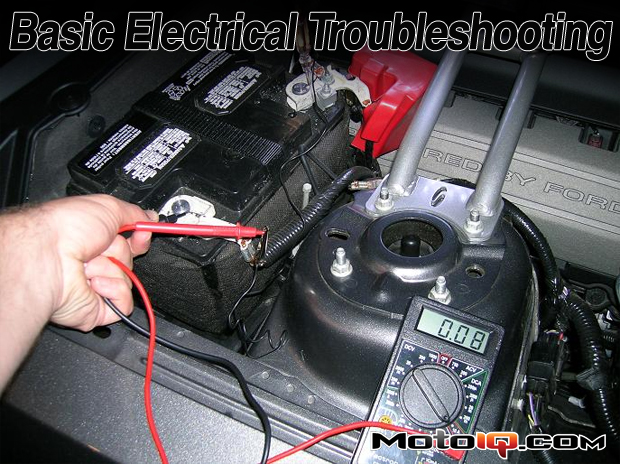

Basic Electrical Troubleshooting
By Vince Illi
In my ongoing quest to make people less scared of automotive electrical systems, I’d like to talk a little bit about two common electrical troubleshooting tools and how to use them. First, though, we’ll need to quickly review electrical basics:

Remember that current flows through an object, while voltage is measured across an object. Ohm’s law tells us that voltage (V) is the current (I) multiplied by the resistance (R):
V = I R
Before we get into discussing troubleshooting tips, a word of caution is in order: If you are troubleshooting something in an engine’s sensor system (such as fuel injectors, MAF sensors, IAC valves, or the like), first DISCONNECT THE COMPUTER AND REMOVE IT FROM THE VEHICLE. Electronic control units are very sensitive, and their sensor inputs operate on very small voltages and currents. If you accidentally put a higher current or voltage onto an ECU pin than it is designed for, you can easily damage the ECU.
Test Lights
One of the most common tools used to look at a car’s electrical system is the test light. A test light is simply a light bulb with two leads. One lead (the ground) is usually an alligator clip, and the other lead (hot) is usually a sharp spike (or probe).
 |
The test light, while simple to use, really isn’t very useful. Then again, that probe spike can probably be used to kill a vampire or something. |
A test light is the simplest tool around. You connect one end to the chassis (ground) of a vehicle. Then you touch the sharp probe end to a wire or connector pin. If the test light illuminates, the wire or pin is “hot,” or has 12 volts on it.
 |
The positive battery terminal is obviously “hot,” so the test light illuminates. |
Really, though, the test light doesn’t tell you much beyond whether or not a wire is “hot.” It doesn’t tell you voltage, current, or resistance. And it can’t really help you troubleshoot much of anything. For that, we need something more versatile.