• Tech
    • Tech Category
      • Engine
      • Bottom End
      • Rods and Pistons
      • Head and Headwork
      • Cams and Valvetrain
      • Cooling and Heat Management
      • Intake
      • Headers and Exhaust
      • Rotary
      • Engine Management and Tuning
      • Drivetrain
      • Transmission
      • Clutch and Flywheel
      • Differential and Final Drive
      • Driveshaft and Axle
      • Axles
    • Tech Category
      • Suspension
      • Shocks and Coilovers
      • Springs
      • Swaybars
      • Arms and Links
      • Bushings
      • Steering
      • Geometry Correction
      • Suspension Setup and Tuning
      • Brakes
      • Wheels and Tires
      • Fueling
      • Forced Induction and NOS
      • Aerodynamics
    • Tech Cat
      • Electrical
      • Battery and Power Distribution
      • Electronics
      • Wiring
      • Electrical System Education and Troubleshooting
      • Lubrication
      • Interior and Controls
      • Exterior
      • Paint and Bodywork
      • Wraps and Film Protection
      • Exterior Care and Maintenance
      • Data Acquisition and Tuning
      • Fabrication and Safety
      • Tips and How-To
  • Projects
    • Make A-D
      • Acura
      • Integra (DC2)
      • NSX
      • CSF RSX (DC5)
      • BMW
      • E30 (SR20 Powered)
      • E36 323is
      • E36 M3 (Black)
      • E36 M3 (Silver)
      • E39 M5
      • E46 M3
      • E90 M3
      • E46 Racecar
      • Yost Auto E92 M3
      • Yost Auto F82 M4
      • Chevrolet
      • Camaro Gen5
      • Corvette Stingray (C7 Z51)
      • Corvette Stingray (C8 Z51)
      • GMC Canyon
      • Dodge
      • Viper GTS
    • Make E-I
      • Ford
      • E350 Tow Rig
      • F150 EcoBoost
      • Fiesta ST
      • Focus ST
      • Mustang 5.0 (Grey)
      • Mustang 5.0 (White)
      • Mustang S197 (Budget Track Car)
      • Mustang S550 GT
      • Honda
      • Civic EF Racecar
      • Civic Si (Coupe)
      • Civic Si (EP3)
      • Civic Si (Saloon)
      • EJ Civic
      • Polystrand CRX
      • S2000 (AP1)
      • S2000 (AP2)
      • Infiniti
      • G20 Racecar
      • G20 (P10 AWD Turbo)
      • G35
      • G37S
    • Make J-M
      • Isuzu
      • Vehicross
      • Lexus
      • ISF
      • SC300
      • Mazda
      • V8 RX7 (3rd Gen)
      • RX-7 (3rd Gen)
      • RX-7 Restomod (3rd Gen)
      • Skyactiv 3
      • Frankenmiata
      • Miatabusa
      • My Girlfriend’s Miata
      • Mitsubishi
      • EVO VIII
      • EVO IX
      • EVO X
      • CSF EVO X Racecar
      • Professional Awesome EVO VIII
    • Make N-P
      • Nissan
      • 200SX
      • 200SX SE-R
      • 240SX Land Speed Racer
      • 300ZXTT
      • 350Z
      • 350Z Drift Car
      • 370Z
      • GT-R (R33)
      • GT-R (R35)
      • GT-R (Team America BNR32)
      • LS S13
      • NX GTi-R
      • Pathfinder
      • S13 Drift/Grip Do-it-All Mega 240
      • Sentra SE-R
      • Sentra Spec V
      • Silvia
      • STurdteen Drift Car
      • Porsche
      • 991 GT3RS
      • Cayman (987)
      • Cayman T
      • Cayman GTS 4.0
    • Make S-Z
      • Scion
      • FR-S
      • Scion Tuner Challenge FR-S
      • TC
      • Subaru
      • Autocross BRZ
      • Legacy GT
      • STI (gen 2)
      • STI (gen 3)
      • WRX (GD)
      • WRX (VA)
      • Toyota
      • 4Runner
      • AE86 Corolla
      • GR Corolla
      • Starletabusa
      • Supra Mark IV
      • Tacoma
      • Tundra
      • Volkswagen
      • MKIV Jetta TDI
      • MKVI Golf TDI
      • MKVII Golf R
      • Sipster (Rabbit)
    • Other Projects
      • Powersports
      • Aprilia RS50
      • Aprilia SR50
      • Doodlebug
      • Ducati 998
      • Ducati Hypermotard
      • Honda Ruckus
      • Husqvarna TE610
      • Go Karts
      • Other
      • Sim Racer
      • Aurora Cobra
      • Garage
      • NP01 Prototype
  • Features
    • Features
      • Feature Cars
      • Drag Race Cars
      • Drift Cars
      • Land Speed Cars
      • Open-Wheel Cars
      • Rally Cars
      • Road Race Cars
      • Street Cars
      • Time Attack Cars
      • Drag Racing
    • Features
      • Events
      • Drifting
      • Land Speed Racing
      • Open-Wheel Racing
      • Time Attack Racing
      • Rally Racing
      • Road Racing
      • Car Shows
      • Columns
      • SlipAngle Podcast
  • Video
  • Shop *NEW*
  • MotoIQ Garage Services
  • About
  • Shop *NEW*
  • MotoIQ Garage Services
  • About
MotoIQ
MotoIQ
  • Tech
    • Tech Category
      • Engine
      • Bottom End
      • Rods and Pistons
      • Head and Headwork
      • Cams and Valvetrain
      • Cooling and Heat Management
      • Intake
      • Headers and Exhaust
      • Rotary
      • Engine Management and Tuning
      • Drivetrain
      • Transmission
      • Clutch and Flywheel
      • Differential and Final Drive
      • Driveshaft and Axle
      • Axles
    • Tech Category
      • Suspension
      • Shocks and Coilovers
      • Springs
      • Swaybars
      • Arms and Links
      • Bushings
      • Steering
      • Geometry Correction
      • Suspension Setup and Tuning
      • Brakes
      • Wheels and Tires
      • Fueling
      • Forced Induction and NOS
      • Aerodynamics
    • Tech Cat
      • Electrical
      • Battery and Power Distribution
      • Electronics
      • Wiring
      • Electrical System Education and Troubleshooting
      • Lubrication
      • Interior and Controls
      • Exterior
      • Paint and Bodywork
      • Wraps and Film Protection
      • Exterior Care and Maintenance
      • Data Acquisition and Tuning
      • Fabrication and Safety
      • Tips and How-To
  • Projects
    • Make A-D
      • Acura
      • Integra (DC2)
      • NSX
      • CSF RSX (DC5)
      • BMW
      • E30 (SR20 Powered)
      • E36 323is
      • E36 M3 (Black)
      • E36 M3 (Silver)
      • E39 M5
      • E46 M3
      • E90 M3
      • E46 Racecar
      • Yost Auto E92 M3
      • Yost Auto F82 M4
      • Chevrolet
      • Camaro Gen5
      • Corvette Stingray (C7 Z51)
      • Corvette Stingray (C8 Z51)
      • GMC Canyon
      • Dodge
      • Viper GTS
    • Make E-I
      • Ford
      • E350 Tow Rig
      • F150 EcoBoost
      • Fiesta ST
      • Focus ST
      • Mustang 5.0 (Grey)
      • Mustang 5.0 (White)
      • Mustang S197 (Budget Track Car)
      • Mustang S550 GT
      • Honda
      • Civic EF Racecar
      • Civic Si (Coupe)
      • Civic Si (EP3)
      • Civic Si (Saloon)
      • EJ Civic
      • Polystrand CRX
      • S2000 (AP1)
      • S2000 (AP2)
      • Infiniti
      • G20 Racecar
      • G20 (P10 AWD Turbo)
      • G35
      • G37S
    • Make J-M
      • Isuzu
      • Vehicross
      • Lexus
      • ISF
      • SC300
      • Mazda
      • V8 RX7 (3rd Gen)
      • RX-7 (3rd Gen)
      • RX-7 Restomod (3rd Gen)
      • Skyactiv 3
      • Frankenmiata
      • Miatabusa
      • My Girlfriend’s Miata
      • Mitsubishi
      • EVO VIII
      • EVO IX
      • EVO X
      • CSF EVO X Racecar
      • Professional Awesome EVO VIII
    • Make N-P
      • Nissan
      • 200SX
      • 200SX SE-R
      • 240SX Land Speed Racer
      • 300ZXTT
      • 350Z
      • 350Z Drift Car
      • 370Z
      • GT-R (R33)
      • GT-R (R35)
      • GT-R (Team America BNR32)
      • LS S13
      • NX GTi-R
      • Pathfinder
      • S13 Drift/Grip Do-it-All Mega 240
      • Sentra SE-R
      • Sentra Spec V
      • Silvia
      • STurdteen Drift Car
      • Porsche
      • 991 GT3RS
      • Cayman (987)
      • Cayman T
      • Cayman GTS 4.0
    • Make S-Z
      • Scion
      • FR-S
      • Scion Tuner Challenge FR-S
      • TC
      • Subaru
      • Autocross BRZ
      • Legacy GT
      • STI (gen 2)
      • STI (gen 3)
      • WRX (GD)
      • WRX (VA)
      • Toyota
      • 4Runner
      • AE86 Corolla
      • GR Corolla
      • Starletabusa
      • Supra Mark IV
      • Tacoma
      • Tundra
      • Volkswagen
      • MKIV Jetta TDI
      • MKVI Golf TDI
      • MKVII Golf R
      • Sipster (Rabbit)
    • Other Projects
      • Powersports
      • Aprilia RS50
      • Aprilia SR50
      • Doodlebug
      • Ducati 998
      • Ducati Hypermotard
      • Honda Ruckus
      • Husqvarna TE610
      • Go Karts
      • Other
      • Sim Racer
      • Aurora Cobra
      • Garage
      • NP01 Prototype
  • Features
    • Features
      • Feature Cars
      • Drag Race Cars
      • Drift Cars
      • Land Speed Cars
      • Open-Wheel Cars
      • Rally Cars
      • Road Race Cars
      • Street Cars
      • Time Attack Cars
      • Drag Racing
    • Features
      • Events
      • Drifting
      • Land Speed Racing
      • Open-Wheel Racing
      • Time Attack Racing
      • Rally Racing
      • Road Racing
      • Car Shows
      • Columns
      • SlipAngle Podcast
  • Video
  • Tech

Velox Motorsports – FR-S / BRZ Rear Diffuser Development

  • Jeff Naeyaert

Velox Motorsports – FR-S / BRZ Rear Diffuser Development 

by Eric Hazen


The people at Velox Motorsports are our kind of gearheads- engineers who believe aftermarket components should be well-engineered, functional, and shouldn't just look good enough for mass production. With the popularity of the FR-S and BRZ chassis, there has been no shortage of so-called “aerodynamic” products, that are mostly cosmetic and don't have any engineering behind them.

The lack of in-depth engineering within the aero parts industry triggered Velox Motorsports to design their own rear diffuser. They knew that they could improve on what was on the market currently. They wanted to maximize performance, leverage aesthetics, add to their already existing front splitter, and offer additional components not offered to the market previously.

Most readers know what a rear diffuser is- the cool looking thing on the back of a car.  Some of you know that it is there to increase downforce. Fewer readers might know how it works.  Basically, without getting too technical, a car by necessity ends up being shaped like an airplane wing. This is because it is flat on the bottom and has a curved top side. This is needed in order to have a passenger compartment in the middle somewhere.

Through something called Bernoulli's law, in short, faster moving air has lower pressure than slower moving air. The air flowing along the longer path over the roof of the car travels faster than the air going straight across the bottom, thus the body of a car tends to make lift naturally. 

What the diffuser does is make the air flow under the car have a longer path, in addition to serving to spoil the lift. When the air hits the upward curving surface of the diffuser, it accelerates and the pressure drops, reducing lift, or even creating downforce. 

With an extensive background in CFD (Computational Fluid Dynamics) and aerodynamics, this project was a perfect fit for the Velox Motorsports team. Looking at how to do the splitter, Velox decided to develop it around some pre-defined goals- the bullet points of them are listed below.

Project Goals:

  • Decrease lift (produce downforce)
  • Reduce drag
  • Aesthetically integrate it into the vehicle’s exterior to make it look as if it could be an OEM addition
  • Work well with the Velox race front splitter
  • Completely cover up the suspension components directly in front of the rear diffuser to further improve performance.

One of the goals of the project is to ensure the new rear diffuser works well in conjunction with the already popular, Velox Motorsports front race-splitter. Photo credit: Kwaziekeller of FT86club.com

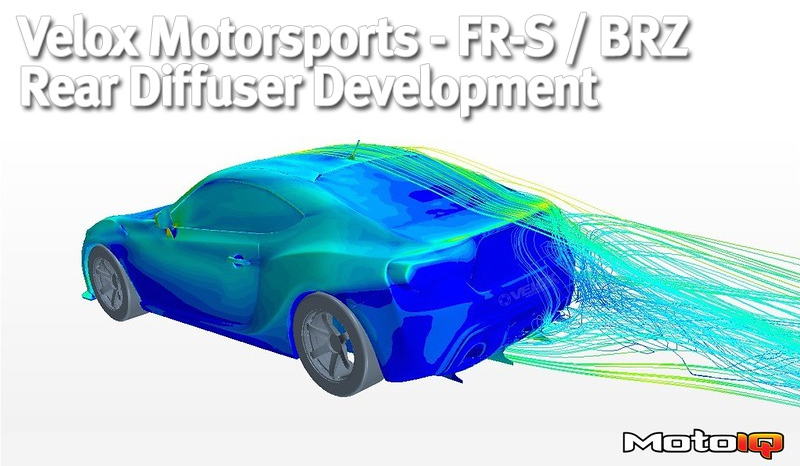
The design of the Velox Diffuser was optimized through CFD analysis. What is CFD analysis? CFD is a computer-aided design tool to help visualize and predict how air will flow and react to a body in motion. 

Engineers use CFD in automotive design to predict and reduce drag, and to minimize lift by increasing downforce. CFD is a faster and more affordable way to design aerodynamic parts- compared to using a wind tunnel or physical testing.   

Using CFD, Velox took multiple parameters of the diffuser, varied the design of them, and then analyzed the results- both numerically and graphically using CFD.

CFD is very computationally intense, and to be able to run the program on a PC, some compromises had to be made to reduce the number of calculations the computer had to run.  

Each analysis of individual design iterations was done using a half-car analysis, since there wasn't any yaw testing performed. This is done using symmetry down the center line of the car. Significantly less computational processing power is necessary when using a half-car model and was the reason behind this analysis approach. 

The meshing, or collection of the car's surface data, was done using first a surface mesh and then a volume mesh. To find a suitable mesh size for the analysis, a grid convergence study was done. A volume mesh count of 10 million cells was considered within the room of accuracy using mesh sensitivity analysis.


Surface mesh on rear diffuser.

The CFD post-processing offers both visualization of the flow and numerical data. Using both of these, Velox made educated guesses as what changes were the most beneficial to optimize the diffusers shape to reach the design goals. Pressure plots allowed the Velox engineers to visualize the location of high and low pressure areas very easily.


Here's a visualization of what the completed product will look like after design and testing. Notice the front extensions that will cover all the suspension components in front of the rear diffuser. Mounting/installation will be a bolt-on affair. 


Bottom view of both rear diffuser and splitter pressure plots shown off the car. Vector and pressure plots allow Velox to see how flow is moving along a plane while viewing pressure on the body components.


1 2 3Next page
Previous Article
  • Uncategorized
  • Tech

PRI 2016: Part 5

  • PabloMazlumian
View Post
Next Article
  • Features

LA Auto Show 2016: Sneak Peek – Porsche 911 RSR

  • Khiem Dinh
View Post
2 comments
  1. Mario Andrado says:
    May 4, 2020 at 12:13 pm

    Hi, i am looking for a aerodynamic race tested rear diffuser for a 2016 Ford Mustang GT running 700 rear wheel horsepower. I already have front splitters, cannards and rear spoiler. I do track sprint racing

    Reply
  2. Brian says:
    July 24, 2020 at 9:01 am

    Hi: I’m working being an amateur aerodynamist with my FRS. Your tuft testing was very good but you should have it without a diffuser to give an overall comparison of the benefit of a diffuser.

    Reply

Leave a Reply Cancel reply

Your email address will not be published. Required fields are marked *

Input your search keywords and press Enter.