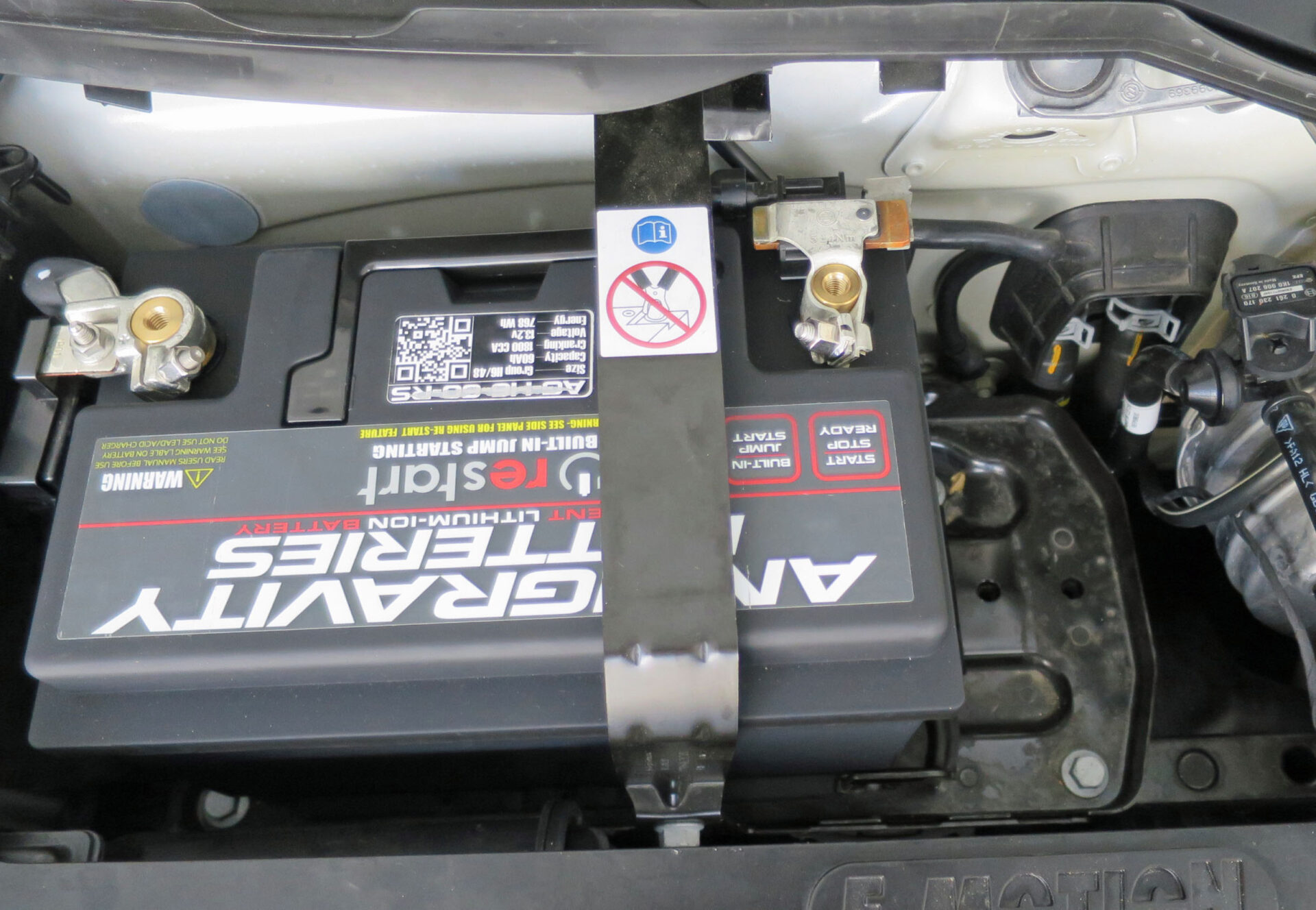

To get the Antigravity battery installed, I had to massage the hole of the steel battery tie-down bracket a bit. After I finished grinding the hole bigger, I hit it up with flat black BBQ paint to prevent rust.

The battery tray already had the hole for the shorter battery which I assume is for the OEM Porsche lithium battery. You can see how much I had to massage the hole based on the prior marks on the bracket; this was before I painted the bracket.

There are ‘+’ and ‘-‘ symbols on the battery to verify the correct cables are hooked up.

Here is everything installed. After reconnecting power to the car, the windows need to relearn where fully closed is in order for the one-touch feature to work. You roll down the windows all the way. Then roll them up all the way and hold the buttons up for a few seconds while the windows are closed. That should do the trick. You’ll also need to set the time on the clock. How much weight did the Antigravity battery shave and what happened to the weight distribution? I’ll get to that in a bit.

It was time for new tires and I decided to step down to 19” tires and wheels from the factory 20” size. The hope was for some reduced mass or inertia, cheaper tires, and a better ride. I decided to go with the latest Titan7 T-P5 model wheels; these share the basic split 5-spoke look of their popular T-5S wheel, but the T-P5 is a stronger design that can handle more abuse. When it comes to wheels, there’s always that balance of mass to strength and durability. For a dedicated race vehicle, wheels are wear items, so one could bias towards very very light wheels. My car is also a street car that has to deal with crappy LA roads, so I decided to go with the updated and stronger T-P5 design that are still quite light. Oh, the purpose of this picture is to show the knurl feature to prevent the tire from slipping on the rim.