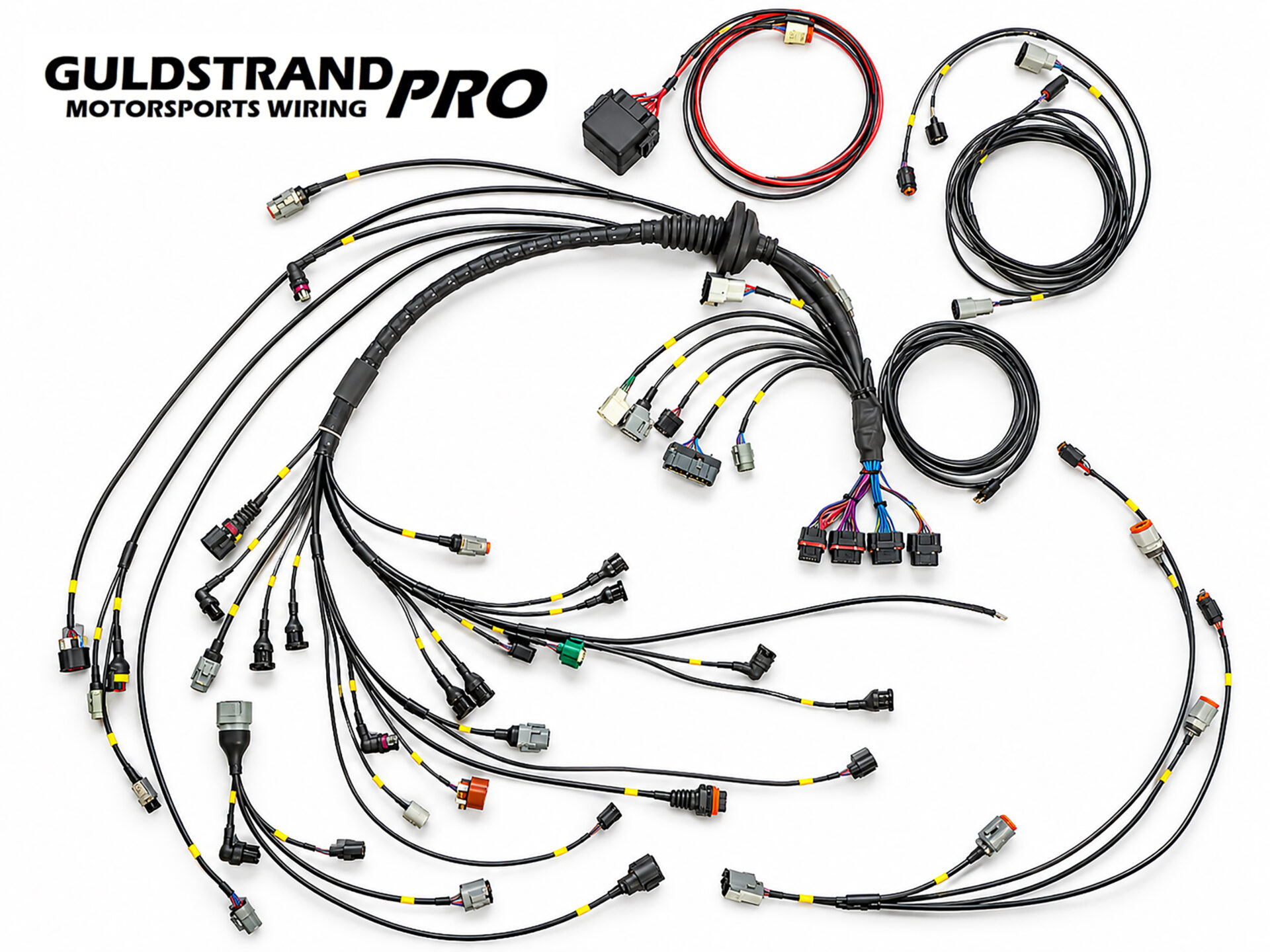
As more wires are added, the wires are concentrically twisted around the original core of knock sensor wires. To properly concentrically twist wires, there is a ratio of how many wires are in the core, and how many wires are wrapped around the core to ensure the entire bundle is flexible. This often requires adding ‘dummy’ wires either to the core or the wires that wrap around the core to ensure the correct number of wires are used. If a wire harness is stiff, the builder did not follow this important rule.

As we worked our way from the furthest connectors towards the ECU, more wires were added to the main core.

At this point, we added all of the connectors to the harness and were ready to do the final concentric twisting to the ECU.

There’s a little bit of an art to proper concentrically twist a harness. Cody at Guldstrand Pro did a lot of this, especially in the tight bulky areas where the different shoots of the harness came together and joints where wires were spliced. We added a few ‘dummy’ wires to the outer bundle so we had the proper ratio of wires that allow the harness to be extremely flexible.

When all of the wires are labeled, covered in DR-25, ATUM Glueline heat shrink, and strain relieved with a zip tie, the harness looks quite nice.