
• Tech
    • Tech Category
      • Engine
      • Bottom End
      • Rods and Pistons
      • Head and Headwork
      • Cams and Valvetrain
      • Cooling and Heat Management
      • Intake
      • Headers and Exhaust
      • Rotary
      • Engine Management and Tuning
      • Drivetrain
      • Transmission
      • Clutch and Flywheel
      • Differential and Final Drive
      • Driveshaft and Axle
      • Axles
    • Tech Category
      • Suspension
      • Shocks and Coilovers
      • Springs
      • Swaybars
      • Arms and Links
      • Bushings
      • Steering
      • Geometry Correction
      • Suspension Setup and Tuning
      • Brakes
      • Wheels and Tires
      • Fueling
      • Forced Induction and NOS
      • Aerodynamics
    • Tech Cat
      • Electrical
      • Battery and Power Distribution
      • Electronics
      • Wiring
      • Electrical System Education and Troubleshooting
      • Lubrication
      • Interior and Controls
      • Exterior
      • Paint and Bodywork
      • Wraps and Film Protection
      • Exterior Care and Maintenance
      • Data Acquisition and Tuning
      • Fabrication and Safety
      • Tips and How-To
  • Projects
    • Make A-D
      • Acura
      • Integra (DC2)
      • NSX
      • CSF RSX (DC5)
      • BMW
      • E30 (SR20 Powered)
      • E36 323is
      • E36 M3 (Black)
      • E36 M3 (Silver)
      • E39 M5
      • E46 M3
      • E90 M3
      • E46 Racecar
      • Yost Auto E92 M3
      • Yost Auto F82 M4
      • Chevrolet
      • Camaro Gen5
      • Corvette Stingray (C7 Z51)
      • Corvette Stingray (C8 Z51)
      • GMC Canyon
      • Dodge
      • Viper GTS
    • Make E-I
      • Ford
      • E350 Tow Rig
      • F150 EcoBoost
      • Fiesta ST
      • Focus ST
      • Mustang 5.0 (Grey)
      • Mustang 5.0 (White)
      • Mustang S197 (Budget Track Car)
      • Mustang S550 GT
      • Honda
      • Civic EF Racecar
      • Civic Si (Coupe)
      • Civic Si (EP3)
      • Civic Si (Saloon)
      • EJ Civic
      • Polystrand CRX
      • S2000 (AP1)
      • S2000 (AP2)
      • Infiniti
      • G20 Racecar
      • G20 (P10 AWD Turbo)
      • G35
      • G37S
    • Make J-M
      • Isuzu
      • Vehicross
      • Lexus
      • ISF
      • SC300
      • Mazda
      • V8 RX7 (3rd Gen)
      • RX-7 (3rd Gen)
      • RX-7 Restomod (3rd Gen)
      • Skyactiv 3
      • Frankenmiata
      • Miatabusa
      • My Girlfriend’s Miata
      • Mitsubishi
      • EVO VIII
      • EVO IX
      • EVO X
      • CSF EVO X Racecar
      • Professional Awesome EVO VIII
    • Make N-P
      • Nissan
      • 200SX
      • 200SX SE-R
      • 240SX Land Speed Racer
      • 300ZXTT
      • 350Z
      • 350Z Drift Car
      • 370Z
      • GT-R (R33)
      • GT-R (R35)
      • GT-R (Team America BNR32)
      • LS S13
      • NX GTi-R
      • Pathfinder
      • S13 Drift/Grip Do-it-All Mega 240
      • Sentra SE-R
      • Sentra Spec V
      • Silvia
      • STurdteen Drift Car
      • Porsche
      • 991 GT3RS
      • Cayman (987)
      • Cayman T
      • Cayman GTS 4.0
    • Make S-Z
      • Scion
      • FR-S
      • Scion Tuner Challenge FR-S
      • TC
      • Subaru
      • Autocross BRZ
      • Legacy GT
      • STI (gen 2)
      • STI (gen 3)
      • WRX (GD)
      • WRX (VA)
      • Toyota
      • 4Runner
      • AE86 Corolla
      • GR Corolla
      • Starletabusa
      • Supra Mark IV
      • Tacoma
      • Tundra
      • Volkswagen
      • MKIV Jetta TDI
      • MKVI Golf TDI
      • MKVII Golf R
      • Sipster (Rabbit)
    • Other Projects
      • Powersports
      • Aprilia RS50
      • Aprilia SR50
      • Doodlebug
      • Ducati 998
      • Ducati Hypermotard
      • Honda Ruckus
      • Husqvarna TE610
      • Go Karts
      • Other
      • Sim Racer
      • Aurora Cobra
      • Garage
      • NP01 Prototype
  • Features
    • Features
      • Feature Cars
      • Drag Race Cars
      • Drift Cars
      • Land Speed Cars
      • Open-Wheel Cars
      • Rally Cars
      • Road Race Cars
      • Street Cars
      • Time Attack Cars
      • Drag Racing
    • Features
      • Events
      • Drifting
      • Land Speed Racing
      • Open-Wheel Racing
      • Time Attack Racing
      • Rally Racing
      • Road Racing
      • Car Shows
      • Columns
      • SlipAngle Podcast
  • Video
  • Shop *NEW*
  • MotoIQ Garage Services
  • About
  • Shop *NEW*
  • MotoIQ Garage Services
  • About
MotoIQ
MotoIQ
  • Tech
    • Tech Category
      • Engine
      • Bottom End
      • Rods and Pistons
      • Head and Headwork
      • Cams and Valvetrain
      • Cooling and Heat Management
      • Intake
      • Headers and Exhaust
      • Rotary
      • Engine Management and Tuning
      • Drivetrain
      • Transmission
      • Clutch and Flywheel
      • Differential and Final Drive
      • Driveshaft and Axle
      • Axles
    • Tech Category
      • Suspension
      • Shocks and Coilovers
      • Springs
      • Swaybars
      • Arms and Links
      • Bushings
      • Steering
      • Geometry Correction
      • Suspension Setup and Tuning
      • Brakes
      • Wheels and Tires
      • Fueling
      • Forced Induction and NOS
      • Aerodynamics
    • Tech Cat
      • Electrical
      • Battery and Power Distribution
      • Electronics
      • Wiring
      • Electrical System Education and Troubleshooting
      • Lubrication
      • Interior and Controls
      • Exterior
      • Paint and Bodywork
      • Wraps and Film Protection
      • Exterior Care and Maintenance
      • Data Acquisition and Tuning
      • Fabrication and Safety
      • Tips and How-To
  • Projects
    • Make A-D
      • Acura
      • Integra (DC2)
      • NSX
      • CSF RSX (DC5)
      • BMW
      • E30 (SR20 Powered)
      • E36 323is
      • E36 M3 (Black)
      • E36 M3 (Silver)
      • E39 M5
      • E46 M3
      • E90 M3
      • E46 Racecar
      • Yost Auto E92 M3
      • Yost Auto F82 M4
      • Chevrolet
      • Camaro Gen5
      • Corvette Stingray (C7 Z51)
      • Corvette Stingray (C8 Z51)
      • GMC Canyon
      • Dodge
      • Viper GTS
    • Make E-I
      • Ford
      • E350 Tow Rig
      • F150 EcoBoost
      • Fiesta ST
      • Focus ST
      • Mustang 5.0 (Grey)
      • Mustang 5.0 (White)
      • Mustang S197 (Budget Track Car)
      • Mustang S550 GT
      • Honda
      • Civic EF Racecar
      • Civic Si (Coupe)
      • Civic Si (EP3)
      • Civic Si (Saloon)
      • EJ Civic
      • Polystrand CRX
      • S2000 (AP1)
      • S2000 (AP2)
      • Infiniti
      • G20 Racecar
      • G20 (P10 AWD Turbo)
      • G35
      • G37S
    • Make J-M
      • Isuzu
      • Vehicross
      • Lexus
      • ISF
      • SC300
      • Mazda
      • V8 RX7 (3rd Gen)
      • RX-7 (3rd Gen)
      • RX-7 Restomod (3rd Gen)
      • Skyactiv 3
      • Frankenmiata
      • Miatabusa
      • My Girlfriend’s Miata
      • Mitsubishi
      • EVO VIII
      • EVO IX
      • EVO X
      • CSF EVO X Racecar
      • Professional Awesome EVO VIII
    • Make N-P
      • Nissan
      • 200SX
      • 200SX SE-R
      • 240SX Land Speed Racer
      • 300ZXTT
      • 350Z
      • 350Z Drift Car
      • 370Z
      • GT-R (R33)
      • GT-R (R35)
      • GT-R (Team America BNR32)
      • LS S13
      • NX GTi-R
      • Pathfinder
      • S13 Drift/Grip Do-it-All Mega 240
      • Sentra SE-R
      • Sentra Spec V
      • Silvia
      • STurdteen Drift Car
      • Porsche
      • 991 GT3RS
      • Cayman (987)
      • Cayman T
      • Cayman GTS 4.0
    • Make S-Z
      • Scion
      • FR-S
      • Scion Tuner Challenge FR-S
      • TC
      • Subaru
      • Autocross BRZ
      • Legacy GT
      • STI (gen 2)
      • STI (gen 3)
      • WRX (GD)
      • WRX (VA)
      • Toyota
      • 4Runner
      • AE86 Corolla
      • GR Corolla
      • Starletabusa
      • Supra Mark IV
      • Tacoma
      • Tundra
      • Volkswagen
      • MKIV Jetta TDI
      • MKVI Golf TDI
      • MKVII Golf R
      • Sipster (Rabbit)
    • Other Projects
      • Powersports
      • Aprilia RS50
      • Aprilia SR50
      • Doodlebug
      • Ducati 998
      • Ducati Hypermotard
      • Honda Ruckus
      • Husqvarna TE610
      • Go Karts
      • Other
      • Sim Racer
      • Aurora Cobra
      • Garage
      • NP01 Prototype
  • Features
    • Features
      • Feature Cars
      • Drag Race Cars
      • Drift Cars
      • Land Speed Cars
      • Open-Wheel Cars
      • Rally Cars
      • Road Race Cars
      • Street Cars
      • Time Attack Cars
      • Drag Racing
    • Features
      • Events
      • Drifting
      • Land Speed Racing
      • Open-Wheel Racing
      • Time Attack Racing
      • Rally Racing
      • Road Racing
      • Car Shows
      • Columns
      • SlipAngle Podcast
  • Video
  • FR-S
  • Projects
  • Scion

Resurrecting Project FR-S: Greddy Oil Cooler

  • Mike Kojima

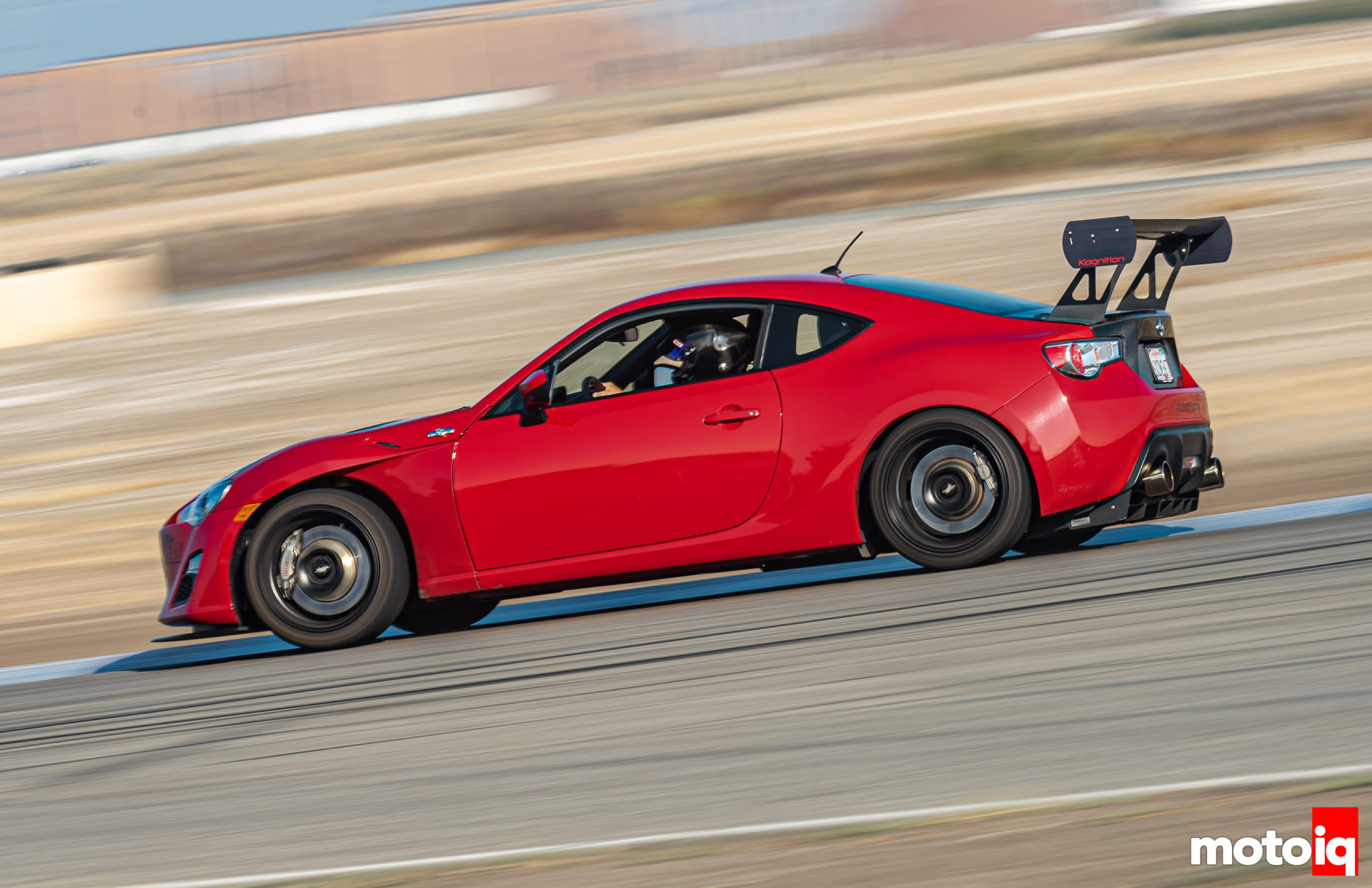
With the Greddy oil cooler in place, we went back to Buttonwillow for another track day, and wow, the temperature-related power reduction issues we had were completely gone.  No longer did the ECU dial back the power as the car got hotter and our power was consistent during an entire session. We also noted that the water temperature gauge was also reading noticeably lower, now it was at the low end of the normal scale even though this day was hotter than the last event, mid 80’s vs low 70’s.  We believe that Greddy’s side mounting of the cooler and our ducting is what was allowing our cooling system to now perform very well.  If you do not want to make the oil cooler duct, we recommend you pay a little more and get Greddy’s kit with the duct or at least have someone build you one.  The duct is a key feature for the cooler’s effectiveness.

If you do some online research, having an oil cooler is essential for driving an FA20 powered car on the track and mandatory if you have an FI FA20. Remember that having synthetic oil that can withstand high oil temperatures isn’t the whole picture, the engine’s bearings losing integrity with temperature is the main issue we are trying to avoid.
Sources

Greddy Performance Products

Related

Previous page 1 2 3 4 5
Related Topics
  • Engine
  • oil cooler
  • Cooling and Heat Management
  • GReddy
  • engine oil cooler
Previous Article
  • Mustang S197 (Budget Track Car)
  • Projects
  • Ford

Project Budget 400WHP S197 Mustang Track Car: Part 6 – Going Through the Suspension with Steeda

  • Billy Johnson
View Post
Next Article
  • Uncategorized
  • Projects
  • Other

Project Cappuccino: Better Braking with Project Mu

  • Dave Zipf
View Post
19 comments
  1. Adrian says:
    April 28, 2021 at 12:12 am

    Great to read another update for this project.

    Do you still have some WiseFab suspension parts to fit to the car?

    Reply
    1. Avatar photo Mike Kojima says:
      April 28, 2021 at 2:20 pm

      The car has Wisefab suspension, look for an article on that coming soon!

      Reply
      1. Adrian says:
        April 28, 2021 at 3:09 pm

        I’m really looking forward to reading that! Thank you for the time and effort you put into these projects, and sharing the process and results of it all. The knowledge and experience you have shared since the SCC magazine days has always been informative and engaging.

        Reply
  2. Joe says:
    April 28, 2021 at 5:38 am

    I really like the cooler, but I swear that somebody told me that anodized surfaces didn’t dissipate heat as well. Not sure if I I am remembering that correctly. Also, I would think that black would be the best color for a cooler.

    Reply
    1. Avatar photo Mike Kojima says:
      April 28, 2021 at 2:23 pm

      Anodized parts don’t dissipate heat as well. This isn’t anodized, it’s paint. Anodizing works on reactive nonferrous metals. Paint doesn’t dissipate heat as well either and neither does bare aluminum or copper with their natural oxide layer as well. You just can’t win! Black does radiate heat better and there are coatings that enhance this.

      Reply
  3. Bob says:
    May 1, 2021 at 3:21 am

    Mike, in your opinion whats the highest acceptable oil temp on track for a street/track car (aka not full race car)?

    Reply
    1. Avatar photo Mike Kojima says:
      May 1, 2021 at 10:09 pm

      Bearings start to lose load-bearing capacity at 260f oil temp, they melt at around 600 degrees so they start to lose strength by the time the measurable oil temp is around 260. The oil is carrying heat away from the bearings.

      Reply
      1. Dan DeRosia says:
        May 3, 2021 at 5:15 pm

        From doing lab R&D for a company that solely did bearings, I’d go a bit more conservative than that; 260F is sort of where I’ve seen stuff drop off a cliff. Bearing overlay is already at about half its room temperature strength at 210F. That’s ignoring what you’re doing to your oil viscosity, though this is talking in terms of temperature at the bearing.

        Reply
        1. Avatar photo Mike Kojima says:
          May 3, 2021 at 5:43 pm

          Yup.

          Reply
  4. Dustin says:
    May 1, 2021 at 10:28 am

    I’ve been running my 93 LT1 Camaro past 300 regularly since 2013. In that time I managed to push an oil seal out, run the car low, and spin a rod bearing. The rest of the rods and all the mains were immaculate. I know the science says it’s bad, but my primitive old knuckle dragging V8 doesn’t seem to mind as long as I keep it full. I don’t even run synthetic, just Valvoline VR1 SAE40. Being a dino oil the straight weight helps with stability. Of course this is a track only car.

    There are 2 items in that kit that caught my eye. First was the cooler orientation. With both ports facing up, there’s the possibility of trapping air in there. On my Camaro I put it in rotated 90 degrees with oil in the bottom and out the top. I understand this is not possible with what you have and what you have definitely works. The other thing was the supplied 90 degree fittings. I went with larger mandrel bent 90 degree fittings on mine out of concern for flow and turbulence.

    Reply
    1. Avatar photo Mike Kojima says:
      May 1, 2021 at 10:13 pm

      Noticed you hit 300 degrees and you spun a bearing? Wonder why? Your oil temp is a big factor in addition to running low. Bearings start to lose strength after 260F oil temp. If anything happens or not depends on how much reserve you have. Stock engine? Maybe more, On the track or modded? A lot less.

      Reply
      1. Dustin says:
        May 2, 2021 at 12:07 pm

        Yes, but I don’t believe the oil temp to have had anything to do with it. The car ended up being a good 2 quarts low and the pickup was JB Welded to the pump and rotated about an inch too high so ignorance on behalf of the PO and me not lifting when I noticed the pressure bouncing mid corner was the cause of death there. 260 is commonly touted as the limit on here but I’m in the minority having an oil cooler at all in my class. I have no doubt that the other cars in my class are hitting 300+ (stock motors) and not blowing up. I’m not advocating to run oil at 300+, but I haven’t seen it be a death sentence myself. I rebuilt the current motor in 2015 and can’t count how many times I’ve raced at 300+. With everyone else doing it, there’s no way it’s luck. I wonder if certain motors are more sensitive than others?

        Reply
        1. Dan DeRosia says:
          May 3, 2021 at 5:20 pm

          Bigger diameter, and chiefly width, means the bearing is less loaded; 260F isn’t “the metal in the bearings has turned to liquid” but “it’s turned delicate as hell” so being comparatively more gentile helps some. Subaru bearings are terrible by this measure and need all the help they can get.

          Reply
          1. Avatar photo Mike Kojima says:
            May 3, 2021 at 5:46 pm

            No one ever believes me when I say this.

          2. Dan DeRosia says:
            May 4, 2021 at 7:40 am

            I should see if I can put together enough not-proprietary data to do a good blog post or something on how bearings work – reciprocating engine bearings are a lot of special cases piled on top of each other. There’s some people who have gone and authoritatively posted a lot of true-but-not-the-full-story data because their engine combination, like many American V8s designed in the 60s, has very generous bearing sizes.

          3. Avatar photo Mike Kojima says:
            May 4, 2021 at 3:03 pm

            I would love for you to do an article on this. No one ever believes me.

          4. Dan DeRosia says:
            May 5, 2021 at 5:52 pm

            I’ll see what I can put together over the next few weeks; probably will have to make my own diagrams of stuff too, to not violate copyright. But I mean, the best I’ve seen in searchable descriptions is a basic steady state fluid film bearing… which is lovely if we were driving gas turbines but piston engines see peak bearing loads that steady state guidelines say won’t work. Even that has some stuff going on that I’ve seen some engineers just not get; I was fortunate to be able to pick the brains of people with PhDs in the subject.

  5. Dustin says:
    May 7, 2021 at 7:34 pm

    My point is that, even if stuff is weaker at that temperature, the effect of it isn’t realized in my small world. I believe you guys that stuff happens at 260, but if it isn’t enough to hurt the motor even long term then why get worked up over it? On a good day my oil only gets up to 270. If you do do the article, it would be great to caveat with things like bearing surface area and point out some motors that you know in particular are and are not susceptible to catastrophic failure north of 260. Also bear in mind our GM cars are saddled with restrictor plates, stock motors with stock rev limits when I make these claims.

    Reply
  6. MattAtPlaton says:
    May 11, 2021 at 11:51 am

    This seems like a great upgrade and some cheap insurance. My only issue is I hate the idea of taking the front bumper cover off my FR-S, only because so many people have broken the side tabs on them. Did you have any issues refitting the bumper cover back on?

    Reply

Leave a Reply Cancel reply

Your email address will not be published. Required fields are marked *

Input your search keywords and press Enter.