
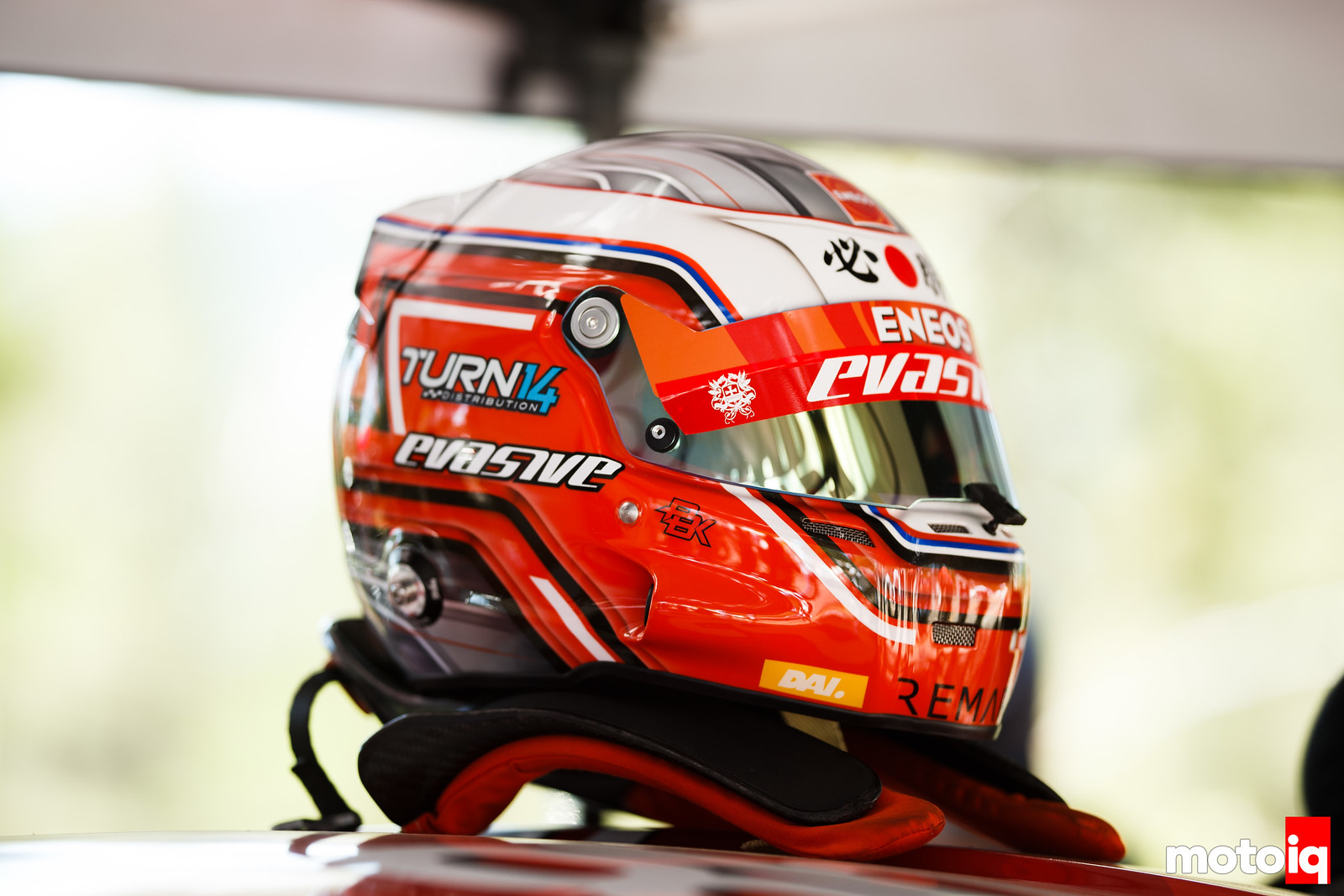

A lot about Pikes Peak is hurry up and wait. We got to our pits and set up at about 3 am, then final checks and tire cooking and then we had a little spare time. All of us were nervous and pensive. Not only is Pikes Peak do or die all attack but it is also very dangerous. I guess this gave all of us the jitters and everyone was unusually quiet.

I took this time to look at some of the machines in the pits next to us. I was looking at the aero details of the RTR NSX front splitter. You could see this endplate was there to reduce spillover, generate stagnation pressure and to created a side vortex.

I looked at the Ducati pits for a sec. This is Kamil Holan’s Streetfighter. I was pretty surprised how close to production this bike was. In Contrast, Carlin Dunne’s prototype Streetfighter had a modded V4 engine that was based on the powerplant of the Panigale and the whole bikes was super trick.

With things under control, I decided to take a quick nap. Bad idea. In the event, the bikes take off first and things were not looking good for them the first 3 bikes off the line crashed and there were long delays as the riders had to be medivaced off the mountain.

We were strapping Dai into the car and preparing to go to the line when we got the word that 4-time champion and the last bike up the mountain, Ducati’s star rider, Carlin Dunne had crashed and died about 15 yards from the finish line. This horrible news put the team’s emotions on edge.

12 comments
Hate having weird mechanical failures like that; that’s racing though.
A lot of the stuff you’re mentioning with temperatures and pressures is really weird; it truly is a different sort of place. Since I’m kind of a data weenie, I’m curious how much DAQ you’re running and if you were finding stuff in the actual run that was massively different to the practice runs.
We have everything for the motor and TC but no suspension pots, etc. I think the most useful thing that we didn’t have would have been turbo shaft speed. I think that has to be managed and monitored carefully.
Interesting – not going too much into what’s your IP, but do you just feel like you have a pretty good suspension baseline / knowledge base on the BRZ from work with it over the years?
Thanks for all that you’re sharing on this – I really do like seeing all of the behind-the-scenes work that’s going into an effort of this scale. Hope that things work out where you guys get another shot at it!
Yeah I know enough to tell you that the FR-S and BR-Z have awful suspension geometry, much of which is damped out by suspension tuning and can actually feel pretty good with minuscule power and grip. The stock suspension problems are toe steer and too much negative camber gain in the rear with too much anti. Too much bushing compliance. General flimsy construction. Weird Ackerman curve. When you up the power to big-time and put big tires on, the car can become almost undrivable.
The Pikes Peak car is sort of the opposite of what the old-timers say to do. We were advised to make the car, high and soft. Instead the car is low and very stiff. In fact, we run the same spring rates we used to win Super Lap Battle a couple of weeks ago. We need to run the car low to make the most out of our limited aero package. Our sorta secret under-car aero needs a low ride height to work. In fact, the difference between Pikes Peak and Time Attack is we run 12mm higher at Pikes Peak to keep the undercar aero off the ground in the bumpy upper part of the course.
One well known Porsche Chassis guy was saying that our setup was bad and he feared for our driver’s life and our car was sparking all over the place. Those were the Ti rub studs. I was pretty happy that our car seemed to be taking bumps better than the other cars I was watching! A lot of this is due to our working with KW suspension on our dampers and our experience at dialing them in.
It seems like a lot of modern cars get away with bad suspension geometry through damper/spring/etc tuning. Of course, older stuff tended to have issues that were just masked by bad tires, and here I’m glaring at the 1st gen RX-7 rear suspension…
Sounds a bit like stereotypical tuning for a downforce car in what you did – or one theory that I’ve heard put sorta like “any geometry can be OK if you don’t let it move much”.
We actually redid the geometry of this car quite a bit. We went from about half an inch toe-out under compression to slightly toe in and we got rid of most of the anti-squat. In the front, we got rid of a lot of the anti-dive and most of the bump steer. With the wide and stiff slicks, this car was really sensitive to toe steer and bump steer. It went from almost undrivable to a good handling car. Our front and under-car aero stuff made a pretty good difference too.
Any idea what Subaru was trying to do with the stock geometry? Something about optimizing for 5/10ths on street tires or something, maybe? It seems like in this day and age there’s too many tools to do analysis to assume that the designer didn’t have something in mind, whether or not it’s what enthusiasts or racers would prefer.
I think that perhaps the parts bin engineering thing either messed up or what happens when we try to put bearings or stiff bushings in a suspension that uses kinematic bind and flex of the OEM bushings to point the wheels in some weird direction. In this day and age where CAD is so good that we can do great stuff at home, I am often incredulous and what a bad job OEMs do with geometry! I guess this keeps me in business.
Mike, would a factory type TPMS system provide enough accuracy to track/datalog tire pressures throughout the race? Would be interesting to know if there are any aftermarket options for using that info.
Possibly but I don’t think we have enough channels. The important stuff is what you start at and what you end up at because you can’t do anything about the middle!
https://trailbrake.com/tire-tpms/ is the only remotely affordable loggable TPMS I’ve yet found. Not used it, no experience with it, but at an order of magnitude less than the next least expensive option I intend to give it a try.
I want shock pots first then these would be interesting.