

WHY A TESLA?
In the car community, Teslas can be polarizing. Their real environmental impact, whether they count as enthusiast cars, the driving experience, politics, and plenty more keep them a constant subject of debate. But there’s a large community of Tesla owners who regularly track their cars, and a thriving aftermarket that helps them improve performance and handling and customize their cars to their own taste. To me, that alone settles whether Teslas are enthusiast cars.
My own reasons for buying one came down to two things: operating costs and Tesla’s Full Self-Driving (FSD) capability. Trucks and sports cars are fun to drive, but they can be expensive to run and absolutely miserable in stop-and-go traffic in big cities. I’ve considered myself a driving purist my entire life, the guy who only wanted manuals and loved driving for its own sake. But years of long commutes in traffic slowly wore that part of me down, and the Tesla became a no-brainer.

OPERATING COSTS (“Gas Mileage”)
Our Tesla Model 3 got the equivalent of 154 mpg over 8,000 miles of driving in Los Angeles! That’s a big claim, so let’s do some car-guy math.
As of 2026, California’s average gas price is over $6.00 per gallon, compared to a national average of about $4.37. Since we’re in California, we’ll keep it simple and use $6 per gallon. You can plug in your own local gas and electricity prices to find your mpg-equivalent.
In California, home electricity runs anywhere from $0.15 to $0.85 per kilowatt-hour (kWh). Tesla Supercharging ranges from $0.25 to $0.60 per kWh, averaging about $0.45.
Hard data: Over 8,000 miles of mixed city, highway, and heavy-acceleration driving, our Model 3 averaged 3.81 miles per kWh.
For the price of one $6.00 gallon of gas in California:
• At $0.15 per kWh (home charging): $6.00 buys 40 kWh, and 40 kWh × 3.81 miles/kWh = 152.4 miles
• At $0.45 per kWh (average Supercharger): $6.00 buys 13.33 kWh, and 13.33 kWh × 3.81 miles/kWh = 50.8 miles
• At $0.85 per kWh (peak home rates): $6.00 buys 7.06 kWh, and 7.06 kWh × 3.81 miles/kWh = 26.9 miles
Even at the average Supercharger rate, a gallon’s worth of money takes our Model 3 50.8 miles, which isn’t bad at all. But almost all of our charging is done at home at $0.15 per kWh, so that same $6.00 gets us 152.4 miles of range, and a full 80% charge of 241 miles costs just $9.49!
RANGE
Our single-motor Model 3 Long Range has an 82 kWh battery with 79 kWh of usable capacity. Charging to 80%, which Tesla recommends for daily use to maximize battery life, gives us 63.2 kWh. At our 3.81 miles/kWh average over 8,000 miles, that works out to 241 miles of range, which matches the range Tesla projects on the dash. Almost none of our daily driving tops 240 miles, so we never need to charge on the road and can always charge at the cheapest home rates.
FULL SELF DRIVE
As an ex-driving purist, I never imagined I’d be raving about someone else driving me, let alone a machine. When I was younger, I took pride in reading a ten-lane highway like a chessboard, scanning far up the road to spot which lanes were backing up and committing to the fastest one.
Today, that joy is gone. Traffic is far worse, and phone-distracted drivers leave massive gaps and make the flow erratic, unpredictable, and frustrating.
Experiencing Tesla’s Full Self-Driving (FSD) in heavy Southern California traffic changed my life. Handing off the mental load of stop-and-go driving cuts down stress and mental exertion significantly. Now I can relax or make drives more productive, taking calls over the car’s excellent audio system. The current Version 14 FSD software manages traffic better than at least 95% of the drivers on the road and Tesla markets FSD as up to seven times safer in terms of accident ratios than the average U.S. driver.
The EV powertrain helps too. With no gear shifts, clutches, or torque converters, starting and stopping is far smoother than in any automatic. But FSD is the real breakthrough. Getting back my time and mental energy improved my quality of life more than I ever expected, and it was the main reason I bought a Tesla.
A year ago, I’d have dismissed this paragraph as the ramblings of a jaded old man. But I’m not alone. Several of my die-hard, EV-hating friends tried FSD firsthand and have since bought Teslas of their own. I now suspect most of the skepticism comes down to resistance to change more than anything else. Besides, I still have manual-transmission sports cars for when I want to actually enjoy the act of driving and doing the three-pedal tango.

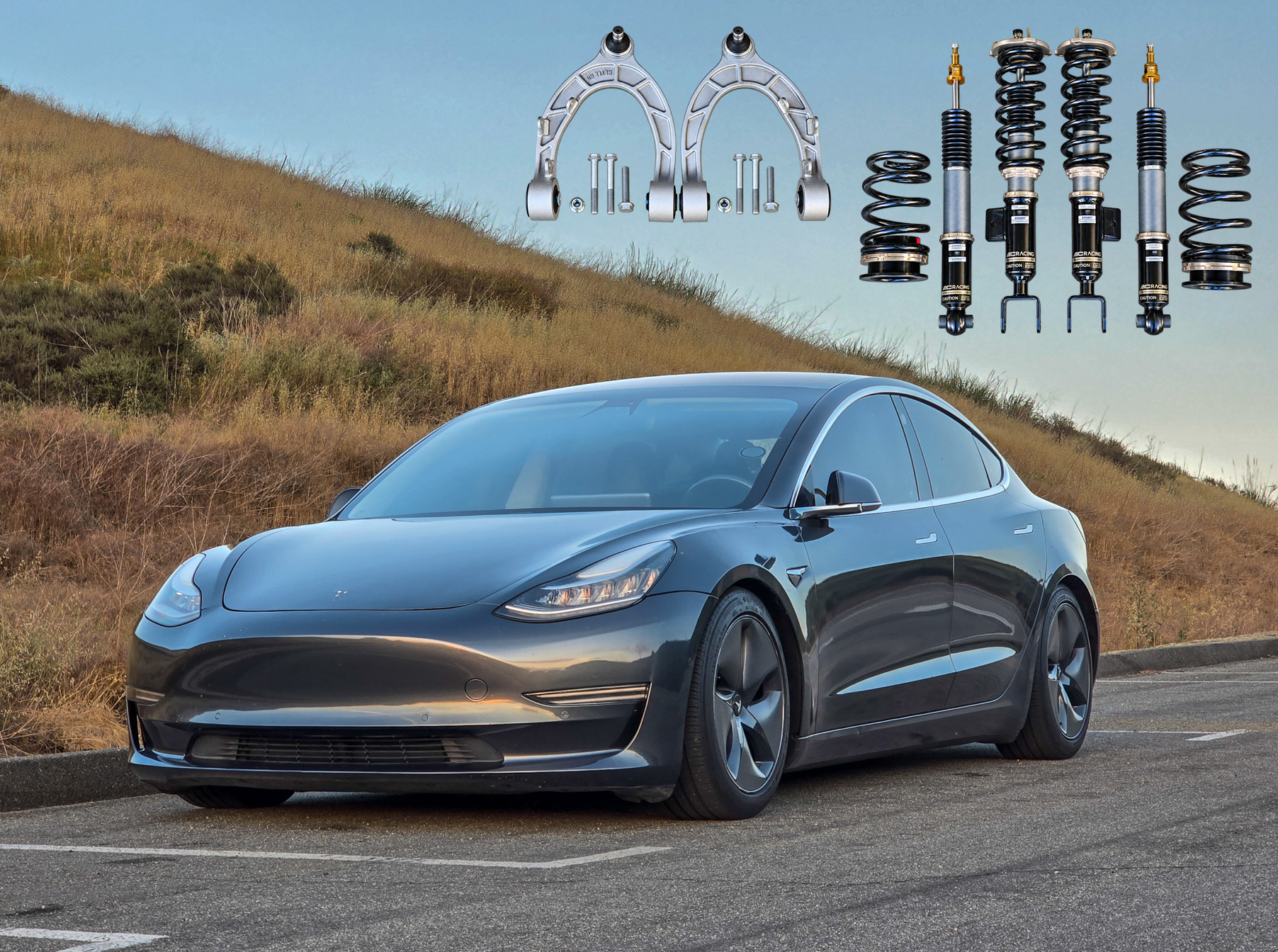
The stock Model 3 front ride height is quite high, creating a pretty significant tire to fender gap.

Out back, the rear ride height is similar but does not look as bad due to the tall rear fender ‘hips’.

From the rear ¾ view, the inset tires and narrow track width and high ride height is mundane and the car looks like every Model 3 on the road, which seems like every other car in Southern California.
5 comments
For some reason I cannot see any photos using multiple browsers.
Are the photo links broken?
Seems fine to me
BTW, is there no “tesla,” section under projects?
The stock upper control arm design is the real story here, and it is good to see it called out. A plastic and steel hybrid arm with a water-trapping ball joint is a failure waiting to happen, especially on a car that sees rain and road salt. Replacing it with a one-piece forged aluminum arm is the right fix, not just a performance upgrade. My tip for Model 3 owners hearing a clunk over bumps is to check that arm first and not let a shop replace the whole strut assembly when the arm alone is the problem, because the cost difference is large and the arm is a known weak point on these cars.
The new Tesla Y-L seems to have a magnetic damper in the rear. It would be interesting to see what the aftermarket brings out for that, that still works with the dash settings, but offers better valving or perhaps an aftermarket controller that offers even more settings than comfort and standard.