
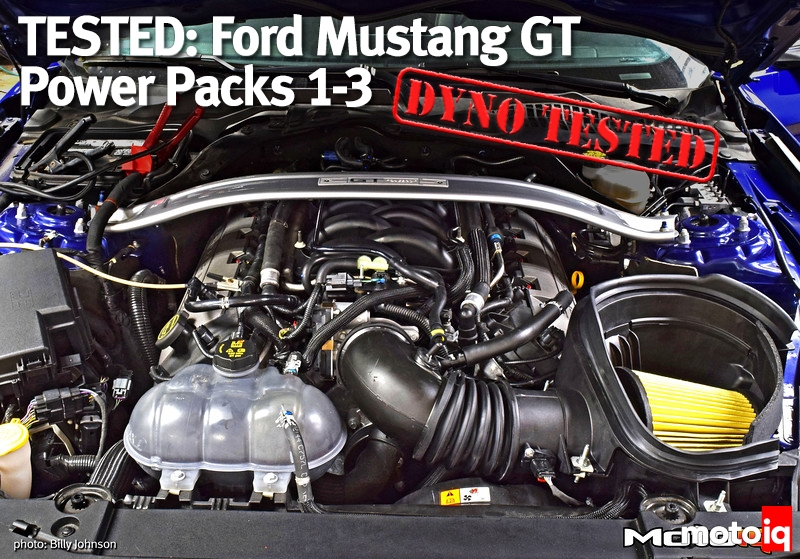

The first step for installing Power Pack 1 is to remove the stock paper air filter.

After removing the 2 clips, the stock air filter slides out and the new K&N panel filter slides right in. This took all but 10 seconds.

Compared to the stock paper filter, the K&N panel filter has much shallower and less restrictive ‘pleats’.
Ford’s Mustang GT Power Pack 1 is easily installed by changing out the panel filter and uploading the new calibration to your car via the included Ford ProCal Tuner. Before we tested the full PP1, we decided to do a few pulls to see the gain in power from just the panel filter alone.
Ford advertises a 13hp & 16lb-ft of torque improvement over stock which is around what we’ve seen K&N air filters do by themselves on our Project E90 M3 (which picked up 13.84whp), Project Dodge Viper GTS (which gained 14.55whp), Project Lexus IS-F (23whp gain), and a Supercharged 2010 Roush Hammer (which picked up 20.07whp).
Needless to say, we are big fans of K&N filters here at MotoIQ. So, let’s see what a K&N filter did to our 2016 Mustang GT:
Stock vs K&N Air Filter

The K&N drop-in panel filter picked up 7.37whp at 6,500rpm and 7.28lb-ft of torque at 4,000rpm. The K&N air filter filled in the stock Mustang’s factory torque dip between 4,000-5,400rpm with an average increase of 12whp and a maximum gain of 19.14whp and 18.61lb-ft of torque at 5,400rpm.
A peak gain of 7whp/tq and a maximum gain of 19whp is a massive increase for the price of a $55 air filter and a 10-second install. Since we didn’t pick up the 13-23whp peak gains that we saw in our M3, Viper, and IS-F, this leads us to believe Ford’s OEM air filter design, layout, and airbox is far more efficient and better engineered since the gain wasn’t as big.
Now that we saw the improvement from the air filter, we were very interested in seeing how much more Ford’s proprietary calibration would do to the 5.0L Coyote V8 since there’s now only 6HP to be gained based off of Ford’s 13HP claimed increase from PP1.

To complete Power Pack 1, we installed the Ford ProCal software on our computer, connected to the internet to retrieve the proprietary software and upload it to the car.
Stock vs K&N Filter vs PP1

After turning the rollers, we were impressed to see a peak-to-peak gain of 11.75whp and 16.46lb-ft of torque over just the K&N air filter. This now puts us as at a 19.12whp & 23.74tq increase over stock, which is 6whp more than Ford’s advertised claims.
The more aggressive calibration tuned for 91+ octane picked up some significant torque in the mid-range and shifted the torque peak from 3,900rpm to 4,300rpm for incredible 30.07whp and 36.74lb-ft of torque maximum gain over stock. It’s interesting to see a prominent torque increase in the 4,000-5,400rpm range which used to be a dip in the car’s stock form. There’s also a nice 5whp and 11lb-ft of torque average increase from a very low rpm below 2,000 to 2,600rpm. Meanwhile, redline was also raised from an actual 6,800rpm stock rev limit to 7,100rpm to improve area under the curve.
For $599, Power Pack 1‘s 19.12whp increase is one heck of a value at $31 per horsepower which is significantly better than the commonly held rule of thumb that says it will cost $100 per naturally aspirated HP increase. As a (he won’t admit – humble) tuner himself, Ken from Palm Beach Dyno was impressed with the gains from Ford’s calibration and commended them for being able to achieve these numbers and close the gap to what most of the aftermarket is able to do, while remaining 50-state legal and under the factory warranty.
Quick Reference:
Page 1 – Power Packs
Page 2 – Baseline Dyno
Page 3 – K&N and Power Pack 1 Dynos
Page 4 – Power Pack 2 Install
Page 5 – Power Pack 2 Dynos
Page 6 – GT350 Intake Manifold Analysis
Page 7 – GT350 Intake Manifold Analysis & Install
Page 8 – Power Pack 3 Dynos
Page 9 – Thrust Analysis of PP3 vs PP2, and Bonus Dynos (M3 & GT350R)
Page 10 – Road Test Review and Overview
19 comments
Hi Addison,
You can read my review of the 2015 Mustang GT here: https://motoiq.com/driven-2015-ford-mustang-gt/
It’s not exactly an apples to apples comparison between the Camaro and Mustang since the Camaro has coolers where only the GT350 is equipped with them and is able to run for laps on end without getting hot. The GT Performance Pack 2 is more track focused in terms of suspension setup (it does not have the issues you stated about the base GTPP) and tire as the 1LE, but it also does not have coolers. The weight of a small-brake base GT may be similar to a Camaro that has coolers and larger brakes. For the street, the performance of the brakes and coolers isn’t relevant. For extended track use, the coolers of the Camaro & GT350 are better choices.
It all depends on what you want. The Camaro is a mechanically great car, but visibility and subjective styling are often cited as negatives towards the car. The S550 chassis is quite good in its own right and it’s quite capable on track in stock form and is faster on track than a DCT-equipped E90 M3 with 50hp more than stock – https://motoiq.com/project-e90-m3-head-to-head-with-2016-mustang-gt/
The 2018 Mustang, especially magneride-equipped cars are a nice improvement over 2015 S550 cars in terms of suspension refinement and performance, so Ford is constantly improving their cars. But for owners of 15-17 cars, there’s the world’s largest aftermarket to modify, tune, and improve cars to whatever you’re looking for. I agree on the subframe bushings, which I did here – https://motoiq.com/tested-steeda-anti-wheel-hop-package/?preview_id=568&preview_nonce=dcf3fc3d14&preview=true
But I probably wouldn’t bother with the toe links or integral link (aka: “Vertical link”).