
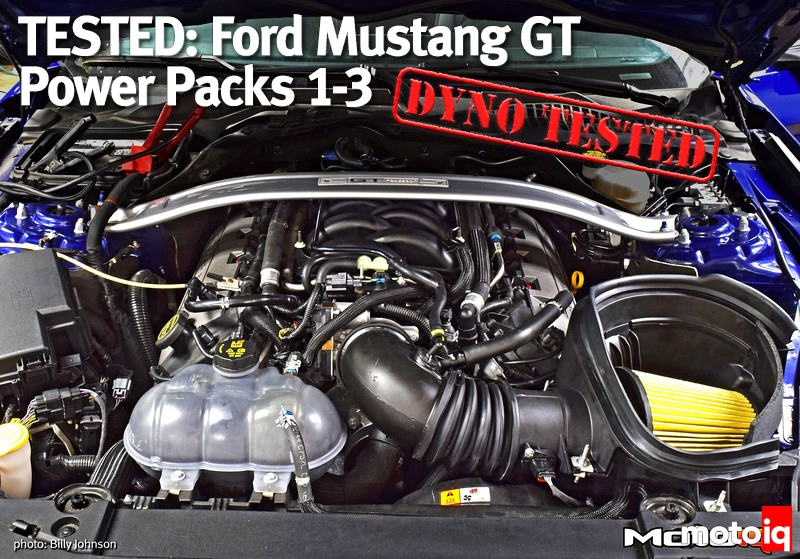
With the Power Pack 3 software uploaded with Ford’s ProCal tool, we were not only eager to see what our gains are compared to Ford’s claim of 37hp and 5lb-ft of torque over stock, but to truly see the effects that the GT350 Intake Manifold has on the torque curve of our engine.
PP3 vs Stock

At first glance, the PP3 is virtually identical to the stock curve up to 4,000rpm where the PP3 starts to notice a significant gain before annihilating the stock curve above 5,750rpm. PP3 results in a 37.3whp and 6.83lb-ft of torque increase over stock, which is right on Ford’s HP claims while being close to 2lb-ft of torque more with a redline of 7,450rpm.
A common internet misconception is that adding the GT350 Intake Manifold to a stock 5.0L Coyote will make it have WORSE low-end torque than the stock. The dyno above shows this to be false. From idle to 3,300rpm, Power Pack 3 actually makes more torque than stock with a maximum increase of 11.78lb-ft at 2,700rpm. There is a 6lb-ft loss between 3,300-4,000rpm but above that, the PP3 blows the stock car out of the water.
It’s interesting to see the GT350 manifold’s shorter runners shifted the HP peak from 6,500rpm to 7,150rpm while the torque peak had an even greater shift from 3,900rpm to 5,000rpm. The general trend is a flatter torque curve due to the increased bottom-end, flattened out mid-range, and a greatly improved top-end.
PP3 vs PP1

PP3 and PP1 are essentially the same with a little back and forth trade-off up to 2,900rpm where PP1 has significantly more midrange with a maximum 21.15whp and 16.91lb-ft torque advantage at 4,300rpm. However above 5,800rpm, PP3 destroys PP1 with a peak power advantage of 18.18whp and making a substantial 44.14whp and 32.76lb-ft of torque more than PP1 at PP1’s 7,100rpm redline.
It’s more appropriate to compare the Power Pack 3 to PP1 which is also tuned for 91+ octane. In this apples:apples comparison, PP3 has an almost identical bottom-end to PP1 before losing out in the mid-range from 2,900-5,800rpm which is in the fat of the rev range when driving on the street. However, above 5,800rpm, PP3 comes into its own and stretches its legs with a flat and rising HP curve all the way to its higher 7,450rpm redline, where the stock manifold is gasping for air.
Now the stock intake manifold’s best variant is in the form of Power Pack 2. Here’s how it compares to PP3.
PP3 vs PP2

PP2 is essentially PP1 bumped up across the board by 6lb-ft of torque. This makes for a 25.94whp and 31.81lb-ft tq advantage over PP3 at 4,300rpm. PP3 (Green) actually makes slightly more torque than PP2 (Blue) below 2,000rpm and from 2,600-2,800. However, PP2 has a torque spike at 2,250rpm and there is an even more prominent torque advantage in the midrange from 2,900-6,000rpm.
PP3 comes into its own by shifting the entire powerband to the right by 300rpm, where it’s 11.23whp peak power advantage is flanked by a flat power curve rather than dropping significantly over the last 5-600rpm past its peak power like stock, PP1, and PP2 suffer from. At PP2’s redline, PP3 is making an impressive 40.35whp and 29.75lb-ft of torque more before carrying that power a few hundred rpm longer to its 7,450rpm redline.
Power Pack 2 represents Ford’s best effort at making power with the stock Mustang GT intake manifold. However, in a general sense, it’s impressive that the GT350’s intake manifold in PP3 really didn’t give up low-end torque despite having such significant high-rpm gains. Realistically, PP3 only lost out to PP2 in the mid-range from 3,000-6,000rpm where at worst, PP3 makes the same power as PP2 but 500rpm later.
So how does PP2 compare to PP3 in terms of real-world performance?
First you need to look at what ‘real-world’ conditions you will be operating the car in. On a racetrack or drag strip, the goal is to optimize performance, speed, and lap times. Thus, it is necessary to make every shift at redline. On the street, redline shifts are not possible in every gear from a practical and legal standpoint, so more time is spent at lower and mid-range RPM.
Since most street driving is done between 2,000-5,000rpm, the higher torque and power in this range from Power Pack 2 would make more “Area Under the Curve” (AUC) and a no-brainer choice for a daily driver.
On the racetrack where shifts happen at redline, it’s a little more complicated to analyze PP3 vs PP2 when there is a 300rpm redline difference and different powerbands. In order to do this properly, we need to look at the car’s gear ratios and torque curves for each package. So, let’s look at a 3.73:1 equipped Mustang GT Performance Package on 275/40-19s:
| Gear | Ratio |
| 1st | 3.657 |
| 2nd | 2.430 |
| 3rd | 1.686 |
| 4th | 1.315 |
| 5th | 1.000 |
| 6th | 0.651 |
| Final Drive | 3.73 |
Quick Reference:
Page 1 – Power Packs
Page 2 – Baseline Dyno
Page 3 – K&N and Power Pack 1 Dynos
Page 4 – Power Pack 2 Install
Page 5 – Power Pack 2 Dynos
Page 6 – GT350 Intake Manifold Analysis
Page 7 – GT350 Intake Manifold Analysis & Install
Page 8 – Power Pack 3 Dynos
Page 9 – Thrust Analysis of PP3 vs PP2, and Bonus Dynos (M3 & GT350R)
Page 10 – Road Test Review and Overview
19 comments
Are there mods in the works to use the ’18 intake manifold for the 15-17 GTs? I’m looking at PP2 for my ’15, but don’t want to jump if there’s a chance something better is to come along soon.
Thanks!
Jim. I can’t speak officially, but given the offering of PP1-3, I don’t think a 2018 intake manifold is going to be offered from Ford as a Power Pack kit.
PP2 is worth every penny . Get airraid Ford Performance blue reusable cone filter and must be installed by dealer to keep warranty . $160 extra cost me. Now Voodoo being over a grand and stock 2018 intake is $400. Sounds good and no brainier since 2018 performs 99% of Voodoo but much cheaper. So I asked Ford Performance for ProCal stage 3. They will not sell it. Essentially you have to give up warranty since you have to use a 3rd party tune or dish out for part and labor. It is a shame but Ford Performance is a separate entity. Anyways 2018 is stock; I would assume PP2 ProCal is enough… But there is a separate tune for ProCal 3; or at least that is what I am being told and what I am trying to debunk… The motor does adjust fuel ratio but I am not sure if the variance between the two intakes is within the margin of acceptance or not…
I wanted to note that Ford Performance reference dyno’s are on a 100% stock exhaust and 91 octane. 93 octane provides about 5 hp more peak than 91 as they have an Octane Learn algorithm built into the calibration just like the stock calibration has an Octane Learn. Greatest power will be made on 93, but 91 is the minimum “premium” available every where in the US so that is often used as the worst case and rightly so despite the fact that the majority of states 93 is commonly available.
An X-pipe will provide about another 5~7 hp. LMR’s stock GT PP with 3.73 and manual dynoed at 395 whp with just the Ford Performance GT350 quad tip cat back exhaust. Stock it should dyno at 390 whp on 93, that’s a 12% drive train loss which is right in the ball park of what Mike Goodwin at Ford Performance quoted as a typical range between 10% and 12%.
That same car put out a peak of 421 whp with a Power Pack 2 and full cat back exhaust on 93 octane. 421 whp * 1.12 = 471.5 HP at the crank. So an X-pipe and 93 octane provide you about 10~15 hp combined gain over their stated 456 hp output on 91 with a stock exhaust and the OE “brief case” resonator.
LMR’s dyno was also a 5th gear pull unlike yours, so their numbers are a bit more accurate as to actual output due to lower gearing losses just as you noted.
Of an interesting note, the exceptionally efficient 5th Generation LT1 6.2L in the 2014+ Corvetts and 2016+ Camaro SS’s weighs 465 lbs and has an average HP to weight ratio of 0.70 hp / lb, going by peak power it’s 0.99 hp / lb. The average calculated from 2500 RPM to it’s 6500 RPM red line as is based on actual wheel hp, not crank. The peak number is based on crank. It’s a much more useful measure average than peak power as the mid-range has a huge impact on average acceleration of the car.
A stock 2nd generation 5.0 weighs in at 445 lbs and has an average power to weight ratio of 0.67 hp / lb. The big bore GM out classes it big time in the mid range of the power band and makes about 45 HP more on average in the 5000 RPM range.
Power Pack to turns the tables and the little Ford 5.0 puts out nearly identical power. In fact the power bands of a Power Pack 2 5.0 are so similar, you can literally take the LT1’s dyno graph, shift it 500 RPM higher in the rev range and you have a Power Pack 2 5.0 with the 5.0 making a little more on the lower end from 2000 to 4750 than the LT1 if you compare the areas of the shifted graphs.
Average whp of a stock 5.0 = 300 from 2750 to it’s 6800 RPM rev limit. Yes the stock 5.0’s rev limit is 6800 RPM not 7,000. It’s only 200 RPM more than the LT1’s 6,600 rev limiter despite the capability of the rotating assembly to rev out to 7450 rpm.
Average whp of a stock 5th gen LT1 6.2L is 323 whp from 2500 rpm to 6500 rpm.
Power Pack 2 makes 337 whp average with a cat back exhaust. Pretty good for a $650 power pack that’s covered under warranty and a $1500 cat back exhaust. Power pack 3 blazes in at 352 whp average. Power Pack 2 is Ford’s version of the LT1 more or less. Very similar power band, just shifted higher up in the RPM band. Honestly it’s more ideal for tighter road courses where Power Pack 3 is more ideal for larger road courses. If you spend more time in the mid-range Power Pack 2 will deliver higher average power and it makes more power all the way up to 6,600 RPM when Power Pack 3 starts to take over and keeps going all the way up.
Both Ford OEM and Ford Performance (aftermarket parts) quote their power figures on the readily available 93 octane, however they are calibrated to be able to handle 91 octane, but with reduced power: “Premium fuel, 91 octane or higher, is required”.
Check out our test of the Ford Performance (by Borla) quad-tip exhaust & GT350 valence cat-back where we saw a 7whp gain: https://motoiq.com/tested-ford-performance-cat-back-exhaust-and-gt350-valence/
It’s great to see LMR have similar results to ours, which meet or exceed Ford’s power increase claims of their Power Packs. As it’s mentioned in the article: since our test car was a standard GT with 3.31 gears, in order to prevent hitting the top speed governor before the rev limiter, we had to do the pulls in 4th gear which typically read ~10whp lower than 5th gear with 3.73s.
“Efficiency” typically refers to HP/L, in which case the 6.2L LT1 makes 73.39hp/L while the far more efficient Gen-2 5.0L Coyote makes 87hp/L. Yes the LT1 has a large displacement for its weight and matches the power of the Coyote for a similar weight, but 3 extra cams, 16 extra valves, and larger heads all add weight in the name of efficiency for the Coyote. The LT1’s larger displacement gives it a torque advantage at lower rpm, which is typically better for street driving, depending on the gear ratios.
Your analysis is a bit flawed. Analyzing just the engine’s output is narrowly focused and does not tell you a whole lot about the actual performance of the car. Because the Camaro has more torque and longer gear ratios (which offset some of that torque advantage), you really need to calculate the thrust curves in the way that was done in the article, which take gear ratios, final drive ratios, tire size, redlines, etc… into consideration to properly be able to compare the two cars.
Looking at the “average whp” of a given engine over its entire rpm band is a bit simplistic and does not tell you a whole lot. In such case, the motor with more torque and a lower redline will always have the advantage. In deciding on a Camaro vs Mustang, PP1-2-3, you really need to look at your budget and intended purpose and use of the car, and select an option that best fits that usage and intended rpm range. For street driving, and low RPM shifts, shifting the powerband lower to maximize that range would be better than choosing a car or modification that raises peak power at the cost of low RPM torque. For example, a Honda S2000 is pretty gutless below 5,000rpm. It’s a fun car, and some people like the character of that engine and are fine with downshifting and wringing it out to get going. For those who don’t like to shift, want instant response, and who don’t like revving engines out, the 2.0L I-4 wouldn’t be their cup of tea. There isn’t always a ‘right’ or ‘wrong’ but rather what best fits the needs for each person.
I think you misunderstood what I was getting at, I was trying to compare engine power output over it’s useful rev range irrespective of what car it isn or gearing of the transmission. Is the POTENTIAL power actually there.
Before gearing and weight of the car is even considered, the potential power has to be there. Then it comes down to how efficiently is the power utilized. But if the power isn’t there, assuming two cars are utilizing their available engine power 100%, the car making less power will always be at a disadvantage. So the question is, can Ford build an engine that can compete against the 5th Gen LT1 6.2L?
Average wheel power of each engine and it’s iteration over a bandwidth of 4,000 RPM of operation:
Stock 2nd Gen 5.0: 300 average whp from 2750 to 6750 (rev limit 6800)
Stock 5th Gen LT1 6.2: 323 average whp from 2500 to 6500 (rev limit 6600)
Power Pack 2 2nd Gen 5.0: 337 average whp from 3000 to 7000 (rev limit 7150)
Power Pack 3 2nd Gen 5.0: 352 average whp from 3500 to 7450 (rev limit 7450)
Stock 3rd Gen 5.0: 370 average whp from 3500 to 7500 (rev limit 7500)
2015-2017 GT 6M Base Model: 3705 lbs (this is Ford’s official spec)
2015-2017 GT 6M + Performance Package: 3780 lbs (optioned lightly)
2016-2018 Camaro 1SS 6M: 3685 lbs (GM’s own spec)
2016-2018 Camaro SS 6M 1LE: 3747 lbs
A stock 2015-2017 GT will ALWAYS be slower than a stock 2016-2018 SS in terms of acceleration assuming all other factors are equal because it makes less average power and weighs slightly more (depending on which version you have).
However, when equipped with a Power Pack 2 and cat back exhaust, the average power in the 2015-2017 GT, which uses a 2nd Generation 5.0, is actually higher than a stock LT1 which is pretty impressive for a $750 modification.
So your no longer at a power to weight disadvantage. It then comes down to how effectively power is applied (gearing and tires) and of course handling capabilities of the car (assuming same driver, same track, same conditions, same tires).
Comparing JUST the engines, irrespective of what car they are in (using a 4,000 RPM rev range in the meat of the power band for each engine, it’s most useful range):
5th Gen LT1 6.2L weighs 465 lbs and has an average crank power output of 362 HP from 2,500 RPM to 6,500 RPM giving it an average power to weight ratio of 0.78 HP / LB.
2nd Gen Coyote 5.0L weighs 445 lbs and has an average crank power output of 335 HP from 2,750 RPM to 6750 RPM giving it an average power to weight ratio of 0.75 HP / LB.
Power Pack 2 2nd Gen Coyote 5.0L weighs 445 lbs and has an average crank power output of 377 HP from 3,000 RPM to 7,000 RPM giving it an average power to weight ratio of 0.85 HP / LB.
Power Pack 3 2nd Gen Coyote 5.0L weighs 445 lbs and has an average crank power output of 394 HP from 3,500 RPM to 7,500 RPM giving it an average power to weight ratio of 0.89 HP / LB.
3rd Gen Coyote 5.0L weighs 440 lbs and has an average crank power output of 414 HP from 3,500 RPM to 7,500 RPM giving it an average power to weight ratio of 0.94 HP / LB.
So the 2nd Gen 5.0 lags the 5th Gen LT1 6.2 when it is stock, but produces more power per it’s own weight than the LT1 when equipped with a Power Pack 2 or 3. The 3rd Gen 5.0L is superior to the LT1 and modified 2nd Gen 5.0L in terms of it’s power to weight ratio as an engine.
Now that we know the power is there, the question becomes can we effectively utilize that power, if not then it’s useless regardless of how good the engine is. But the point I was getting at is that a handle full of car enthusiasts in Ford’s performance engine engineering department outdid 6 million dollars of R&D development GM put into the 5th Gen LT1 6.2L, which is a very good engine itself.
It’s easier to maker higher average power with engines that rev out when you don’t have a torque multiplier like a Turbo or Super Charger. Higher revving engines will always make higher average power per their weight than bigger displacement torqier engines.
Torque is useless if it’s not combined with RPM and it’s easier to make power by applying smaller moments of toque more times per second than massive moments of torque a few times per second. Power is what matters ultimately even though power is made by applying torque x times per second.
Higher revving NA engines simply have better average power. Now for daily driving, the bigger displacement or FI engines producing a higher percentage of their power in the lower RPM range are more useful. But for performance driving you only need a strong mid-range and top end. Low end is irrelevant, your not going to go fast around a track in either a Camaro SS or a Mustang GT by running both engines at 1,500 RPM…
Best acceleration is achieved by applying the higher average power. So my entire point was even though the 2nd Generation 5.0 lags the latest 5th Gen LT1 by a decent amount, the Power Pack 2 brings it up to par plus a little more and it’s power band (where in the RPM range the highest average power is achieved) is nearly identical to the LT1 if you shifted the LT1’s entire rev range up just 500 RPM.
Now weather Ford’s gearing in their MT-82 can effectively utilize that is another story , but the power is there if it can be effectively utilized. Phew, that was a lot, but hopefully at least gives you confidence that if your Power Pack 2 GT is slower on a track than the 6th Gen Camaro SS, it’s not because it makes less power, it’s because either your not using the power as effectively or the handling or your driving is inferior.
It’s a lot easier to change suspension components and increase driving skill than it is to make substantially more power reliably which is why this matters.
Not really. The engine’s torque curve, rev limit, vehicle weight, mpg targets, emissions, performance targets, etc.. all dictate the gear ratio chosen for a given platform. “The car making less power will always be at a disadvantage” is also incorrect if said car is lighter and has shorter gearing, more gears, and a faster shifting transmission. While it’s interesting to compare the performance of the engine by itself, its erroneous ignore all of the other factors when comparing the entire package of one car vs another.
Your ‘average wheel horsepower’ over a 4,000rpm spread is probably most relevant for street driving, because when driving on a road course or drag strip and shifting at redline, the mustang only has a 2,500rpm drop during the 1-2 shift, and has a smaller and smaller rpm drop at redline as you go through the gears. As you narrow your ‘average wheel horsepower’ spread, the LT1’s advantage will quickly shrink. This is why you need to analyze the THRUST CURVES to have a better idea of the acceleration rate/ability of each car.
Don’t forget that gears are torque multipliers.
I do understand what your saying in that the 5.0 makes more power per a liter, but ultimately that’s irrelevant and I completely disagree in it’s relevance. Here’s why:
F = Mass X Acceleration.
As long as the engine can be packaged in a physical size that will fit into the chassis, what matters is how much average power does it make vs. how much of it’s own mass it has to move. Power per a liter doesn’t really matter if the smaller displacement engine were to be substantially heavier.
Suppose the 5.0 had a cast iron block and weighed 100 lbs more but all other things are still the same. It would still have the same 87 HP / L, same external size, same cams, same ECU programing etc. but now it has to move 100 lbs more of mass. Suppose it goes into the same car with the same gearing as the aluminum block version. It’s going to run a 1/10th slower in the 1/4 mile ever time…despite having the same power per liter, the same average power, same chassis, same gearing etc.
When building an engine for maximum power relative to it’s own weight it’s displacement relative to it’s power doesn’t matter unless it helps you optimize it’s power to weight ratio. Take the LT1 vs. the Coyote for example. The LT1 uses only 16 valves and a single cam located in the block with a single cam phasor.
The heads on the LT1 are quite small relative to the Coyote because there’s almost NO valve train up top, just the valves, rocker arms and push rods, all the rest is nestled down in the block. So despite it’s 1.2L of extra displacement, it’s external dimensions are very similar to the smaller displacement 5.0 because as you mentioned the Coyote has two cams and cam phasors on each bank (4 total) which adds to it’s weight and size. To they off set one another and the end result is similar dimensions and weight.
However, when it comes to average power, if both engines are using the same technologies (variable valve timing and direct injection), higher flowing, higher revving engines will always make more average power. Without a torque multiplier, you can’t get around the fact that it’s physically easier to hold torque over a long RPM range than to make huge torque over a shorter RPM range.
The LT1 is slightly more cubic in it’s external dimensions while the 5.0 is slightly shorter but wider. Given they are reasonably similar in their dimensions, what matters is how much average power does each engine make relative to how much of it’s own weight it has to move.
So when comparing one engine to another, we need to look at average power over the range of operation because its being used at 3,000 RPM, 4,000 RPM, 5,000 RPM etc. and how much mass does it have to move.
The 2nd gen 5.0 makes less power per it’s weight than the LT1 even though it’s 20 lbs lighter. When we equip the 2nd Gen 5.0 with a Power Pack 2, it now makes more power per it’s weight on average even though both engine’s peak power is about 455. Moving your power band up in the rev range leverages the average effect of toque.
Power = (Torque X RPM) / 5252. So even if your torque is lower on the 5.0, because it’s all shifted up in the rev range, torque is being applied more often per a minute so the average work being done is higher relative to it’s own mass.
That’s why I say low end torque is more of a misnomer and relatively useless in terms of performance applications. It’s usefull for daily driving so long as the torque is adequate to move the car, but acceleration is going to be far lower at 2000 RPM than at 5,000 RPM even if the torque output is identical. Work being done is what matters, how much average work can an engine do over the RPM range your using it at and how much mass does it have to move?
I understand your argument of the LT1’s displacement to weight ratio puts a less efficient engine design and layout at a torque advantage when equaling the weight of the far more efficient 4-valve Coyote, but volumetric efficiency of an engine is absolutely relevant and extremely important. Shrink the 6.2L LT1 down to the same displacement of the Coyote and it will make nowhere near the power. Larger, less efficient engines struggle to meet ever tightening emission standards, which is one of the reasons that killed off the 8.3L V10, which weighs a little over 500lbs and makes 640hp. The power to weight ratio of that V-10 probably trumps both the Coyote and LT1 in your 4,000rpm “average wheel horsepower” analysis. But that does not mean it’s efficient in terms of power density, fuel economy, emissions, etc…
It’s not really proper to compare a Direct-Injected 455HP 6.2L LT1 (11.5:1 CR) to a Port-Injected 435HP 5.0L Gen-2 Coyote (11.0:1 CR). You really need to compare the PI LS3 to the PI Gen-2 Coyote, or the DI LT1 to the 460hp 5.0L DI Gen-3 Coyote (12.0:1 CR).
If you want to building an engine for maximum power relative to it’s own weight, you add forced induction. If you want to stay NA, you either increase its displacement or efficiency and redline, both of which have their own challenges. Due to the EPA, the shift in the auto industry is for smaller, more efficient FI engines. You’ll likely see a DOHC motor replacing the pushrod LS/LT line sooner than later.
It’s actually extremely difficult to make torque over a wide RPM range (especially at high RPM) than it is to make a lot of torque over a short RPM range.
An engine with more torque requires a drivetrain with stronger and heavier components to handle the torque. That means more weight. 20-50lbs differences in the weight of the block isn’t always crucial compared to the variables of the supporting components of the car. It’s difficult to isolate and compare just the engine when looking at two different cars without considering the entire package because the engine does not have to simply move its own weight, but the entire car.
Without going into detail about selecting ideal gear ratios, if you’re comparing a Coyote to an LT1 for a planned engine swap in a different platform, and that platform has a drivetrain that can handle the power, torque, and RPM of both options, then your analysis would be a little more appropriate. But analyzing just the engines of two different cars is too narrowly focused to draw proper conclusions.
I just love this discussion. Thanks for keeping it civil.
I’ll say this, the power band of both the Power Pack 2 2nd Gen 5.0 is pretty impressive for a PI NA engine. Power Pack 3 is even more impressive. The 3rd gen 5.0 has a power band that has the mid-range of Power Pack 2 with the top end of Power Pack 3 and weighs 5 lbs less. It’s an impressive engine to say the least.
But Ford used the 5.0 because of their 100mm bore spacing requirement due to their tooling. GM used the 6.2 for the same reason, that’s what they were set up to manufacture. I know Cadillac is releasing a twin turbo 4.4L V8 that is DOHC / Direct Injection, so there are absolutely benefits to using it, but 6.2 or 5.0 are just two different ways to get there. Power output is what matters. As you said, you can get there by making a lot of torque over a short rev range or by making less torque but over a longer rev range. Ultimately the highest average power however is achieved with smaller displacement higher revving engines if your not going to Forced Induction because all engines are air pumps and higher flow rates are more easily achieved through rev range rather than bore size up to a point.
But I digress, the Power Pack 2 really changes this car and it’s darn impressive to me that a Port Injected 5.0L makes slightly more power than the mammoth (by comarrrison) DI 6.2L from GM just by giving up low octane fuels and a new intake.
I don’t expect we’ll see power gains that large on NA V8 engines again. Im not sure why they left so much on the table. It’s far more common for an NA engine to be tuned darn close to it’s limits and giving up low octane fuels nets you only a small gain of 5~7 hp like with the 1st gen 5.0’s.
6800 RPM rev limit, 87 octane and the stock intake really crippled the 2nd gen 5.0 whose bones are of the Boss 302 plus some new goodies (like mid-lock cam phasors and revised heads etc.).
Billy, what are your thoughts on the S550 chassis? I’ve heard so much internet here say about the Alpha from GM being “superior” because it’s “lighter” or more rigid or both. Yet the base model weight of a manual GT is 3705 lbs. The base model weight of the latest alpha based SS is 3685 lbs. That’s only 20 lbs difference….
However it seems the GT gains a lot more weight with the Performance Package. Larger radiator, loaded hood, larger brakes and the biggest weight adder, the PP staggered wheels which add 32 lbs where GM is using lightweight Forged wheels to keep the weight gain to a minimum, although a fully equipped 1LE clocks in at 3747 lbs. However the 1LE blows the doors off a GT PP in terms of suspension tuning. It’s no contest.
For some reason the “Performance Package” seems to only give you the power train goodies but doesn’t really add much in suspension tuning, Performance Package suspension tuning on a GT is more like base model tuning for an SS…but with the added cooling capabilities and Torsen LSD. I much prefer the S550 chassis as a street car over the Alpha. And obviously the architecture supports exceptionally fast variants (GT350), but the factory tuning seems quite lacking (just like the anemic tuning of the 2nd gen 5.0 and how much power is left on the table).
The IRS bushings are still compliant, the outer toe links don’t use spherical bearings and allow deflection, only the inner ends use spherical bearings. The PP springs and strut combination can be very “bouncy” and oscillate and still allow more body roll than you’d expect…yes those are easy fixes with a Ford Performance track handling pack (or you can make your own version like I did by using BMR CB005 IRS cradle lockout, BMR SP080 performance lowering springs on stock PP struts and FP outer Toe link bearings).
I’m not sure why, but it seems their stock “Performance Package” is really geared towards giving you the most important hardware as a foundation while leaving the real suspension tuning up to the owner (or in many cases the Ford Performance packages). It seems Ford Performance upgrades or similar packages from other vendors is where the GT’s really come to life.
Hi Addison,
You can read my review of the 2015 Mustang GT here: https://motoiq.com/driven-2015-ford-mustang-gt/
It’s not exactly an apples to apples comparison between the Camaro and Mustang since the Camaro has coolers where only the GT350 is equipped with them and is able to run for laps on end without getting hot. The GT Performance Pack 2 is more track focused in terms of suspension setup (it does not have the issues you stated about the base GTPP) and tire as the 1LE, but it also does not have coolers. The weight of a small-brake base GT may be similar to a Camaro that has coolers and larger brakes. For the street, the performance of the brakes and coolers isn’t relevant. For extended track use, the coolers of the Camaro & GT350 are better choices.
It all depends on what you want. The Camaro is a mechanically great car, but visibility and subjective styling are often cited as negatives towards the car. The S550 chassis is quite good in its own right and it’s quite capable on track in stock form and is faster on track than a DCT-equipped E90 M3 with 50hp more than stock – https://motoiq.com/project-e90-m3-head-to-head-with-2016-mustang-gt/
The 2018 Mustang, especially magneride-equipped cars are a nice improvement over 2015 S550 cars in terms of suspension refinement and performance, so Ford is constantly improving their cars. But for owners of 15-17 cars, there’s the world’s largest aftermarket to modify, tune, and improve cars to whatever you’re looking for. I agree on the subframe bushings, which I did here – https://motoiq.com/tested-steeda-anti-wheel-hop-package/?preview_id=568&preview_nonce=dcf3fc3d14&preview=true
But I probably wouldn’t bother with the toe links or integral link (aka: “Vertical link”).
Wow! Very impressive discussion. But for me, a 69 YO guy with a 2017 Mustang GT maunal, PP, is the Ford power pack 2 with out cat back or x-pipe enough to make me say holy Sh__! What an upgrade!
I have had Ford Performance Power Pack 2 installed for few months and love it. There are a lot of swaps with 2018 intake manifold being saturated online. Has anyone tried 2018 intake manifold with Ford Performance Power Pack 2? I am just wondering if I need a tune like procal from power pack 3 if it is indeed different than PP2 procal. The issue is you cannot get PP3 procal without purchasing voodoo intake manifold. The reason is why if 2018 swap yeilds little variance in HP and TQ.
That is exactly the question I have. Has anyone provided an answer? Goal
: torquey 500 whp that doesn’t fall off at 6800 rpm.
I ‘m a proud portuguese owner of one of the few extants 2015 Ford Mustang GT in Portugal and altough the custom car is fantastic I had a Performance Power Pack stage 3 installed in my car by Porto Ford dealer CAM some months ago-the first in Portugal just for the record.
So I want to share with you my experience.
I had already a K&N cold air system and airfilter that produced a very nice sound when the rev’s climb up to 3.500 and when that power pack was installed and I drove it for the first time I was disappointed with the sound I heard, nevertheless the car gained a different behavior.
I recall that with the previous K&N device my Mustang GT had already a power gain about 16 HP ( I don’t remember torque gain), nevertheless I drove to the Highway (far from police control) to test it and my initial sadness turned to a smile when the REV’s reached 5000- my Mustang seemed to be gaining increasing propulsive force till 7.500 and this was clearly noticed even in 5th gear an on climbing.
On 5th gear the car reaches easilly 260 Km/h
It was worth installing this Power pack after all.
Some days after by advice of the CAM’s engineer the original paper airfilter was changed for a K&N airfilter used in the Shelby’s GT 350 and the sound improved although not as nice as before,
Even without replacing exhaust system exhaust sound iis a bit stronger with this Power Pack 3 and fuel consumption does not increase (exception if you’re always revving high which is a bit dificult not to do if you have free road before you…)
To sum up I’m very satisfied with this Performance Power Pack 3 and from a user’s point of view I corroborate all technical opinions in this excellent Tests
I’m glad to hear you like the Power Pack 3. It does change the character of the car and it won’t be the best option for everyone – mainly people who want low end torque and who don’t want to rev the car out.
Hello, I just made the change from a power pack 2 to a power pack 3 and I cannot get the pp3 tune file to download. The ProCal3 provides an error message but the source of the error isn’t clear. Did you have to restore the factory tune between packages or is there are other trick to getting the file to download to the pro cal?